INSIDER TAKE
How Cheap Are Apartments in Japan, Really? What the Low Prices Hide
Yes, you can find apartments in Japan for the price of a used car — and most of them are cheap for reasons that will cost you more than the discount. A Tokyo-based insider explains why ultra-cheap listings exist, what the realistic price bands look like, and when a cheap price is genuinely a deal.
On this page 6
TL;DR: The headlines are real — Japan has apartments listed for less than a used car. But “cheap” in Japan is not a mispricing; it is the market correctly pricing depreciation culture, shrinking regional demand, leasehold land, heavy monthly fees, and buildings no bank will finance. The sticker price is often the smallest number in the deal. Cheap can still be a good buy — for the right purpose, in the right location, underwritten honestly — but the discount always has a reason, and your job is to know which reason before you wire money. (All figures directional, as of writing.)
Yes, the Cheap Listings Are Real
Search any Japanese property portal and the numbers jump out. Apartments in regional cities for ¥3–5 million. Suburban resort-era condos for under ¥1 million. Rural houses that cost less than the furniture inside them. For a buyer used to London, Sydney or San Francisco pricing, it reads like a typo — and with a weak yen converting everything into dollars or euros at a discount, the arithmetic looks even more absurd.
The listings are genuine. You can really buy them. The question that matters is why they cost that little — because in Japan, unlike in most Western markets, an ultra-low price is rarely an inefficiency waiting for a clever foreigner to arbitrage. It is usually the market functioning with brutal accuracy.
Why Ultra-Cheap Property Exists in Japan
Five structural forces produce the sub-¥5M listing, and every cheap property you will ever look at is priced by some combination of them.
Buildings depreciate to zero. Japanese practice treats the building as a consumable that loses value over decades — wooden houses fastest, concrete condos more slowly — while only the land holds value. A 40-year-old apartment is priced like a 40-year-old car, regardless of how charming the renovation photos look. This is cultural and institutional, baked into bank lending and tax schedules, and it does not care that your home country prices old buildings as “character.”
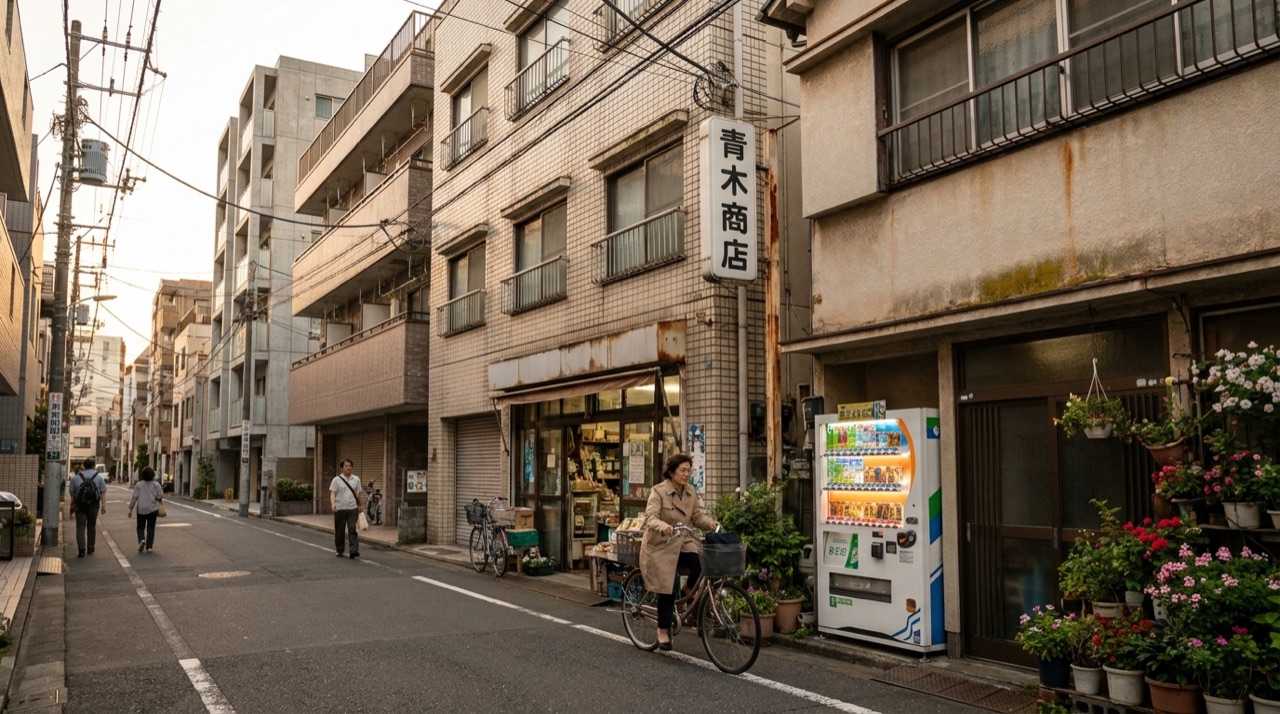
Shrinking demand outside the metros. Japan’s population is falling everywhere except the biggest urban cores. In regional cities and rural areas there are more homes than households and the gap widens every year — that is the akiya (vacant house) phenomenon, and it means the marginal buyer for much cheap stock simply does not exist. A price with no queue behind it keeps falling.
Leasehold land. Some strikingly cheap listings sit on leased land (shakuchiken): you own the building, rent the ground under it, and face ground rent plus renewal complications. Priced correctly, leasehold trades at a deep discount to freehold — the mechanics are here — but a first-time foreign buyer scanning for the lowest number often does not notice which one they are looking at.
The management-fee trap. A condo’s sticker price is only the entry ticket. Every month, forever, you owe the management fee (kanrihi) and repair reserve (shuzen tsumitatekin) — and in aging buildings with few remaining owners, those fees climb steeply because fewer households share the same elevator, roof and plumbing. Resort-era condos in onsen towns are the extreme case: units listed for ¥100,000 because the monthly fees are ¥30,000–50,000 and the seller is paying you to take the obligation. The monthly-carry math is here — read it before any “bargain” condo.
No-financing buildings. Banks draw hard lines: old buildings that miss earthquake standards, units below minimum floor area, leasehold structures, and most rural stock are difficult or impossible to mortgage. No financing means every future buyer must pay cash — which shrinks your resale market to a sliver and is itself a reason the price is low. You inherit the same illiquidity on the way out.
What Prices Actually Look Like, Band by Band
Precision here would be false — prices move, and every building is its own story — but the honest, indicative shape of the market looks like this (directional, as of writing):
- Rural and deep-suburban Japan: the sub-¥5M world. Old wooden houses, resort condos, akiya. Real, plentiful, and priced for near-zero local demand. This is lifestyle territory, not investment territory.
- Regional cities (prefectural capitals and similar): commonly roughly ¥5–20M for older secondhand condos. Functional stock, thin liquidity, flat-to-declining land values in most locations.
- Greater-metro fringes (outer Osaka, Nagoya, Fukuoka suburbs, outer Greater Tokyo): roughly ¥15–40M depending on age and station distance. Here demand exists but is selective — the walk-to-station rule starts deciding everything.
- Central Tokyo 23 wards: a different market entirely. Typical secondhand family condos run from the ¥30 millions well into nine figures in the core, and the central wards have been appreciating — on price-per-square-meter, Tokyo is still cheap versus London or Hong Kong, which is the version of “cheap Japan” that actually has an investment case.
Notice the pattern: the cheaper the band, the weaker the force holding prices up. Japan is a two-speed country — the same yen that buys a whole rural house buys a few square meters in Minato, and the two are not the same asset class wearing different prices.
What a Cheap Price Really Costs
Underwrite any cheap listing with the full stack, not the sticker:
- Closing costs of roughly 6–10% — agent commission, acquisition tax, registration, scrivener — itemized here. On a ¥3M unit the percentage stings less, but the fixed components loom proportionally larger.
- Renovation that routinely exceeds the purchase price. Old stock needs plumbing, wiring, insulation, sometimes structural work — realistic renovation numbers here. A ¥2M purchase plus ¥10M of works is a ¥12M property that may still appraise at ¥4M when you finish.
- The forever fees. Kanrihi and repair reserve on a condo, or full self-funded maintenance on a house, plus annual property tax — small in absolute yen on cheap stock, but they never stop, and they are the same whether the unit is rented, used or empty. Estimate the tax line with our property tax calculator.
- The exit. The hardest question in cheap Japanese property is never “can I buy it?” — foreigners can, freely and with the same taxes as locals — it is “who buys it from me?” If the honest answer is “another cash-paying foreigner who found the same listing,” you own an option on a very thin market.
When Cheap Is Genuinely Good
None of this means cheap is always wrong. It means cheap needs a purpose. The cases that hold up:
- You will actually use it. A cash-purchase house or condo you live in, or genuinely use as a base in Japan, is consumption with a real yield — housing yourself — and the depressed price works entirely in your favor. Many happy foreign owners of cheap Japanese homes exist. Almost none of them bought expecting resale profit.
- Land value dominates the price. A cheap old house on well-located, freehold urban land near a station is really a land purchase with a free (and disposable) building on top. Price the land, ignore the structure, and the math can genuinely work.
- Motivated-seller discounts on otherwise-normal stock. Japan’s inheritance wave is pushing estates to sell inherited homes on a tax deadline — that dynamic produces properly discounted, structurally fine property, increasingly on the edges of Greater Tokyo rather than the deep countryside. This is the closest thing to a real bargain channel in the cheap end.
- You are buying yield you have verified, not imagined. Some regional units rent adequately to local tenants at gross yields that look spectacular against the tiny price. Occasionally real — but verify occupancy, tenant depth and the fee stack line by line, because an 8% gross yield in a shrinking city can lose to 4% in Minato once vacancy and exit are priced.
The disqualifier, in every case, is buying cheap because it is cheap — the absolute price standing in for analysis. ¥3M feels like nothing next to a Western deposit. It is still ¥3M plus fees plus renovation plus carry for an asset that may have no bid when you want out.
What This Means For Your Next Move
Japan really is one of the cheapest developed markets in the world to buy property — at two completely different levels. At the bottom, prices are low because value is leaving; at the center of Tokyo, prices are “low” only by global-city comparison, because value is arriving. Decide which trade you are actually making before the sticker price makes the decision for you.
Three concrete steps. One: for any cheap listing, build the full number — price, closing costs, renovation, monthly fees, annual property tax — and then ask who the next buyer is. Two: if your goal is investment rather than lifestyle, compare that full number against central-Tokyo math with the net yield calculator; the answer is often uncomfortable. Three: if you want the honest read on a specific cheap listing — leasehold or freehold, financeable or not, land value versus building fiction — talk to us. We would rather kill a bad bargain for you now than watch it cost you triple the discount later.
Sources: MLIT (Ministry of Land, Infrastructure, Transport and Tourism), Statistics Bureau of Japan — Housing and Land Survey, Real Estate Information Network / REINS market data, JETRO — investing in Japan