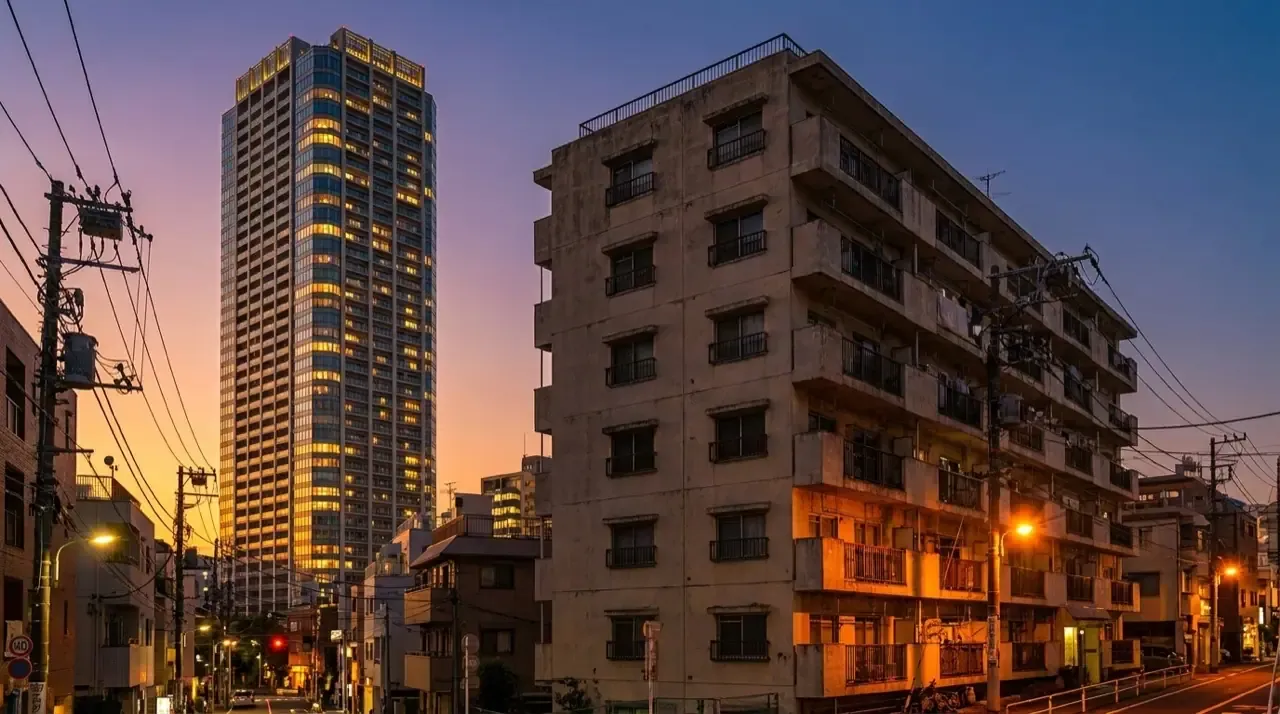
STRATEGY & YIELD
Kanrihi and Shuzenhi: Monthly Cost of a Tokyo Mansion
A Tokyo-based insider explains kanrihi and shuzenhi, how to read the repair reserve and long-term plan, and how these monthly costs quietly eat your net yield.

On this page 5
TL;DR: Every Tokyo apartment carries two monthly fees on top of your loan: kanrihi (the building management fee) and shuzenhi (the long-term repair reserve). Foreign buyers fixate on the headline price and forget this monthly carry, which can quietly erase a chunk of your net yield. The real danger isn’t the fee itself but an underfunded reserve that triggers a future lump-sum levy. Read the reserve balance and the long-term repair plan before you sign, not after.
What Kanrihi and Shuzenhi Actually Pay For
When you buy a unit in a Japanese mansion (the standard word here for a concrete multi-unit apartment building, not a detached house), you also buy a share of the common parts: lobby, elevators, corridors, exterior walls, roof, water tanks. Two separate monthly payments keep that machine running.
Kanrihi, the management fee, covers day-to-day operating cost: the cleaning crew, the elevator maintenance contract, common-area electricity, the building manager’s hours, and the fee paid to the kanri-gaisha (the management company that administers the building on behalf of the owners’ association). This money gets spent more or less as it comes in. It is the cost of keeping the lights on.
Shuzenhi, the repair reserve, is completely different in purpose. It is a savings pool. Every owner contributes monthly, and the kanri-kumiai (the owners’ association, which every unit owner automatically joins) banks it for big, infrequent jobs: repainting the exterior, waterproofing the roof, replacing the elevator, and the large-scale renovation cycle the industry calls daikibo shuzen (major periodic repair, typically planned in rough 12-to-15-year cycles, directional, as of writing).
Shuzen tsumitatekin (修繕積立金) is the formal name for that repair reserve fund, also translated as the long-term repair reserve or sinking fund; shuzenhi is the everyday shorthand, and listings and disclosure documents may use either. It is paid every month on top of kanrihi, and it is the building’s savings pot for the big jobs no single year’s budget can absorb: exterior repainting, waterproofing, pipe and plumbing replacement, elevator overhaul. It is also the line item foreign buyers most often underestimate, because new buildings deliberately set it low at launch and ramp it up steeply over time. The point most buyers miss is who carries a shortfall. The reserve belongs to the building, not to the owners who underpaid into it, so if the pot is thin when a major repair falls due, the bill lands on whoever owns the unit at that moment, which could be you. A thin reserve is a red flag about the asset, not a paperwork detail.
Age makes this more pressing on resale stock. The average resale condo that changed hands in Tokyo’s 23 wards in August 2026 was 26.86 years old (REINS Market Watch, August 2026; a 23-ward average, so the mix of units traded moves it; more official figures on our 23-ward data page). On the 12-to-15-year cycle above, that is around the age of a building’s second large-scale repair (computed: two cycles = 24 to 30 years), which is exactly when an underfunded reserve gets tested.
The distinction matters because one is an expense and the other is, in effect, forced saving you partly get the benefit of later. But both leave your bank account every single month, whether the unit is rented or empty.
How These Fees Eat Your Net Yield
Here is the trap I watch foreign buyers fall into. They calculate gross yield from the asking rent and the purchase price, see a number they like, and stop. Gross yield is a marketing number. Net yield is what you actually keep, and kanrihi plus shuzenhi come out before you see a single yen of profit.
As a rough feel: combined monthly kanrihi and shuzenhi on a typical central-Tokyo condo often land somewhere in the neighborhood of a few hundred yen per square meter for management and a similar order for the reserve (directional, as of writing, and highly building-specific). On a compact investment unit that combined carry can absorb a meaningful slice of gross rent before you even add property tax, insurance, and any rental-management fee.
Run the full stack honestly: gross rent, minus kanrihi, minus shuzenhi, minus koteishisanzei (the annual fixed-asset property tax), minus building insurance, minus vacancy allowance, minus your rental manager’s cut. What’s left is your real return. I have seen units where that monthly fee load turned a “5 percent” listing into something far thinner once everything was netted out (directional, as of writing). Confirm the exact figures with a licensed professional before you model a purchase, because tax treatment varies by ownership structure.
Reading the Reserve Balance and the Long-Term Plan
This is the part almost no overseas buyer asks for, and it’s the single most useful document in the file. Request two things from the seller’s agent.
First, the chouki shuzen keikaku (the long-term repair plan). This is the association’s multi-decade schedule of major works with projected costs and a projected reserve balance year by year. A healthy plan shows the reserve staying positive through each big repair cycle. An unhealthy one shows the balance crashing toward zero or going negative right before a major job, which is a flashing signal.
Second, the juuyou jikou setsumeisho (the important-matters disclosure statement) and the latest association financial summary, which show the current accumulated reserve balance and how many owners are behind on payments. A building where a chunk of owners are in arrears is a building where the working pool is weaker than it looks on paper.
What I want to see: a reserve that has actually accumulated, a plan that’s been revised in recent years rather than left untouched since the building opened, and shuzenhi that steps up over time on a published schedule. Many buildings deliberately start the reserve low to make early sales attractive, then raise it later. If you buy in expecting today’s low fee forever, you have misread the document.
The Underfunded Reserve and the Lump-Sum Levy
Here is the failure mode that actually costs people money. The repair reserve fund is underfunded across a large share of the Japanese stock; surveys by the housing ministry have repeatedly flagged that a substantial portion of associations hold less reserve than their own plans call for (directional, as of writing). It’s a structural problem, not a rare one.
When the reserve is short and a major repair comes due, the association has three options: raise shuzenhi sharply going forward, take on a loan in the association’s name, or vote a ichiji-kin (a one-time special levy, a lump-sum assessment charged to every owner). That last one is the nightmare for an absentee foreign owner. You can be hit with a demand for a large one-off payment, decided by a vote you may not have attended, with little warning. The amount depends entirely on the gap and the building size, and it can run to a serious figure per unit (directional, as of writing).
Older buildings carry a second layer of risk worth naming plainly: earthquake resistance. Japan tightened its seismic code in 1981, and units built to the post-1981 shin-taishin (new earthquake-resistance standard) are generally viewed as more resilient than pre-1981 stock. An older building with a thin reserve and deferred seismic retrofitting is exactly where a painful levy tends to land. Have a licensed professional review the disclosure documents before you commit.
Related reading: Tower Mansion vs Older Mansion Tokyo: A Buyer’s Guide.
What This Means For Your Next Move
Treat kanrihi and shuzenhi as first-class numbers, not footnotes. Before you make an offer, get the long-term repair plan and the reserve balance, model your real net yield with every monthly cost subtracted, and price in the possibility of a future levy on anything older or thinly reserved. A building that costs a little more in monthly fees but has a fully funded, well-managed reserve is usually the safer asset than a cheap-to-carry building quietly heading for a special assessment.
If you want a second set of eyes on a specific building’s documents, or help reading a chouki shuzen keikaku you’ve been handed, Talk to us. You can sanity-check your net-yield math with our tools, and if you’re still deciding where to buy, compare wards to see how fee levels and building age stack up across central Tokyo.
Sources: MLIT mansion management guidelines, MLIT mansion policy portal, Japan Property Central on management and repair fees, REINS Market Watch, August 2026