STRATEGY & YIELD
Tower Mansion vs Older Mansion Tokyo: A Buyer's Guide
A Tokyo-based insider compares glossy tower mansions against older mid-rise mansions for foreign buyers, covering earthquake code, yield, repair funds, and resale.
On this page 6
TL;DR: A shiny tower mansion (tawaman) and a plain 1980s mid-rise are two different bets, not two flavors of the same thing. Towers buy you liquidity, amenities, and a story; older mid-rises buy you land-share value and yield. The single hardest filter for either is the 1981 earthquake-code line. Everything else is a trade-off you can live with.
What Actually Separates a Tower from an Older Mansion
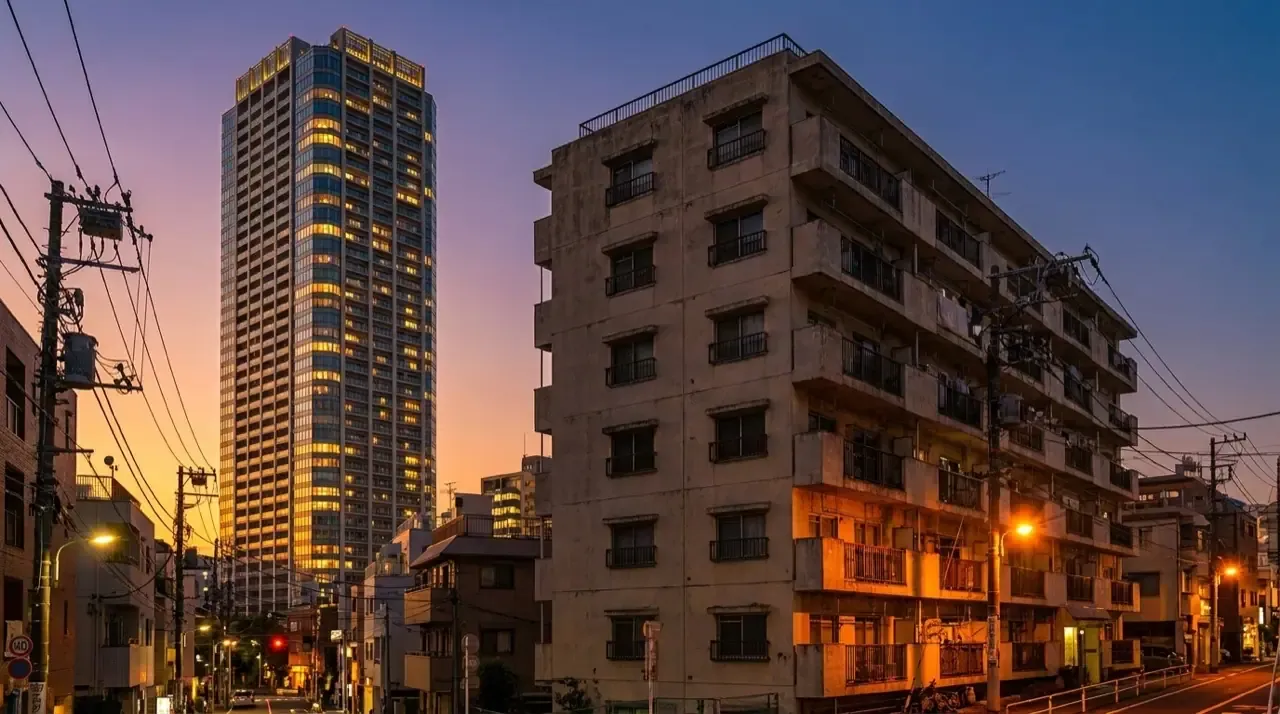
In Japanese listings, mansion (manshon) just means a steel-and-concrete apartment building, not a luxury house. Within that, the tower mansion (tawaman) is the 20-plus-floor glass tower with a concierge, a gym, a party room, and a lobby that looks like a hotel. The older mansion I keep pointing people toward is usually a 5-to-12 floor reinforced-concrete mid-rise built somewhere between the early 1980s and the late 1990s, plain on the outside, often with a bigger land share underneath it than its price suggests.
People frame this as new-versus-old, but the real axis is what you are buying. With a tower you are mostly buying the building and the lifestyle around it. With an older mid-rise you are buying a slice of well-located Tokyo dirt that happens to have a usable box on top. That distinction drives almost everything below, so when foreign buyers ask me the best apartment type to buy in Tokyo as a foreigner, my first question back is always: are you chasing yield, or are you chasing a place to live and a store of value?
Related reading: Detached House (Kodate) vs Mansion in Tokyo: A Foreign Buyer’s Guide.
The 1981 Earthquake-Code Line Is Non-Negotiable
Before depreciation, before yield, before the view, there is one filter I apply to every building: the shin-taishin (new earthquake-resistance standard). Japan tightened its building code in 1981. Structures designed under the post-1981 standard are engineered to survive a major quake without collapse; pre-1981 kyu-taishin (old-standard) buildings were not held to that bar. This is the 1981 earthquake code line for mansions in Japan, and it is a genuine fixed legal standard, not a directional number I’m hedging.
There’s a softer second line in 2000, when standards for low-rise and wood construction were revised again, but for concrete mansions the 1981 cutoff is the one that matters for financing and resale. Many Japanese banks are cautious about lending on pre-1981 stock, which quietly shrinks your future buyer pool when you try to sell.
For the old vs new mansion Japan earthquake question, here’s my honest take: a well-maintained 1985 building that cleared the post-1981 standard is structurally a reasonable bet. A 1978 building at a tempting price is a different animal — sometimes worth it if it has been seismically retrofitted with documentation, but you must confirm that retrofit with an engineer, not take the seller’s word. New towers are all comfortably post-code; that’s one box they tick automatically.
Related reading: New-Build vs Resale in Tokyo: The Buyer Process, Timeline and Real Trade-offs.
Related reading: Earthquake Insurance for Japan Property: A Foreign Buyer’s Guide.
Depreciation, Land Share, and Where the Value Actually Lives
Japanese buildings depreciate hard. The structure is treated as a wasting asset, and for tax purposes reinforced concrete is depreciated over roughly 47 years (directional, as of writing — confirm the exact schedule with a tax professional). In the real world, a new tower carries a new-build premium that can evaporate in the first several years much like a new car driving off the lot (directional, as of writing).
This is where the older mid-rise quietly wins. In an old, low-rise mansion, a large share of your purchase price is land-share value (the undivided ownership interest in the land). Land doesn’t depreciate. So as the building ages toward zero accounting value, the land underneath a well-located mid-rise keeps holding — sometimes appreciating — its worth. In a 40-floor tower, that same land is split across hundreds of units, so each owner’s land share is thin. You’re paying mostly for floors and finishes that depreciate, not dirt that endures.
For a tawaman tower mansion investment, that means your upside leans heavily on the location’s land market rising and on the building staying desirable, not on the land slice you personally hold. It can absolutely work in central Tokyo — it just isn’t the same engine as land-share value.
Repair Funds and Management: The Old-Building Landmine
Here’s the risk that bites foreign buyers who only looked at the purchase price. Every mansion charges a monthly shuzenhi (the building repair-reserve fund) on top of kanrihi (the management/common-area fee). The shuzenhi is supposed to accumulate for big-ticket work — exterior, waterproofing, elevators, and eventually the plumbing risers.
In a lot of older buildings, the reserve was set too low for decades and the fund is underfunded relative to the work coming due. When that happens, owners face a temporary special levy (ichiji-kin) — a lump-sum demand, sometimes a serious five-to-seven-figure-yen one — or a steep monthly increase. Before buying any older unit, read the chouki shuzen keikaku (the long-term repair plan) and the management association minutes to see the actual reserve balance and what’s scheduled. A cheap old unit with a starved repair fund is not cheap.
Towers have their own version of this, and it’s underrated. Tower repair costs are large and lumpy — facade access on a 40-floor building, high-speed elevators, mechanical parking. The first major repair cycle and, much later, the eventual large-scale renewal can drive shuzenhi up materially over the building’s life (directional, as of writing). Glossy lobby today, fat monthly bill in fifteen years. Read the plan for towers too.
Liquidity, Resale, and Who Each One Actually Suits
Towers win on resale liquidity. Brand-name central-Tokyo towers are what overseas buyers and many domestic buyers actively search for, so they tend to sell faster and price more transparently — there are lots of comparable sales. An obscure 1986 mid-rise can take longer to move and needs a buyer who understands what they’re looking at. Liquidity has real value; don’t dismiss it.
So, roughly, who suits what:
- The yield hunter: older, post-1981 mid-rise in a solid ward. Lower entry price, higher gross yield (directional, as of writing), real land-share value. The price of that yield is more diligence on the repair fund and a narrower resale pool.
- The trophy buyer / owner-occupier: the tower. You’re paying a premium for the view, the amenities, the address, and easy resale. Treat it as a lifestyle asset with a long-term cost tail, not a yield play.
Whichever way you lean, two reminders. Remember the non-resident withholding mechanics on a future sale — a buyer is generally required to withhold 10.21% of the gross sale price when the seller is a non-resident — and confirm your cross-border tax position with a licensed professional, because Japan-side and home-country treatment rarely line up neatly. The standard brokerage cap (3% of the price plus 60,000 yen, plus consumption tax) applies on either type, so the building you choose doesn’t change the agent’s fee formula.
What This Means For Your Next Move
If I had to compress thirty years of these buildings into one sentence: buy the older mid-rise for the land and the yield, buy the tower for the liquidity and the life — and run the 1981 code check and the repair-fund check on both before you fall in love with either.
Run the rough numbers yourself first with our tools, and if you’re torn on location, compare wards to see where land-share economics and rental demand actually overlap. When you’ve got two or three candidates, ask your agent for the repair plan and the management minutes on each — and if you want a second opinion on what they show, Talk to us; a real person (me or a colleague) will tell you, plainly, which one looks like the trap.
Sources: Japan Property Central — earthquake building standards, MLIT (Ministry of Land, Infrastructure, Transport and Tourism), National Tax Agency Japan
