INSIDER TAKE
The Boring Superpower: Japan's Rule of Law and Clean Title Make It Asia's Real Safe Haven
Tokyo property isn't a high-yield gamble — it's a capital-preservation play built on a clean central title registry, top-tier rule of law, near-zero violent crime, and decades of policy continuity. Here's why foreign money fleeing riskier Asian markets is hitting record highs in Japan, and how to act on it.
On this page 6
TL;DR: Tokyo property isn’t an exciting yield play — and that’s the point. Japan offers a clean, centrally registered title you can verify before you close, a top-15 global rule-of-law ranking, one of the lowest homicide rates on Earth, and decades of policy that doesn’t change overnight. That boring stability is exactly the product Asian capital is buying right now, and the inflows are at record highs.
The product is stability, not yield
Most pitches for foreign real estate lead with a number: a rental yield, a price-appreciation forecast, a “this market is about to pop” story. Tokyo’s pitch is different, and you should hear it clearly before you wire any money. The thing you are buying here is not a double-digit return. It is the near-certainty that the asset will still be yours, on the same terms, in twenty years — and that nobody can quietly take it from you.
That sounds dull. It is dull. It is also the single hardest thing to find in Asian real estate, and the reason capital is moving.
When money flees an unstable market, it is not chasing the highest yield. It is chasing the place where the deed means what it says and the government will not rewrite the rules between Tuesday and Wednesday. Japan is built for exactly that buyer. If your goal is capital preservation — parking wealth somewhere it cannot be inflated, expropriated, or litigated away — Tokyo belongs at the top of a very short list.
Caveat worth saying out loud: if you need a high cash yield to make the numbers work, central Tokyo will frustrate you. Prime yields are compressed precisely because so many people want the safety. You are paying for the safety. That is the trade.
From the desk — The buyers who lose money in the riskier parts of Asia almost never lose it to a price crash, in my experience, they lose it to title they could not verify, and that is exactly the failure mode I stopped seeing once I started working here. When I pull a registry record from the Legal Affairs Bureau and lay the liens and the true owner on the table before anyone signs, you can watch the relief land on a client who has been burned by a handshake market before.
Clean title you can actually verify
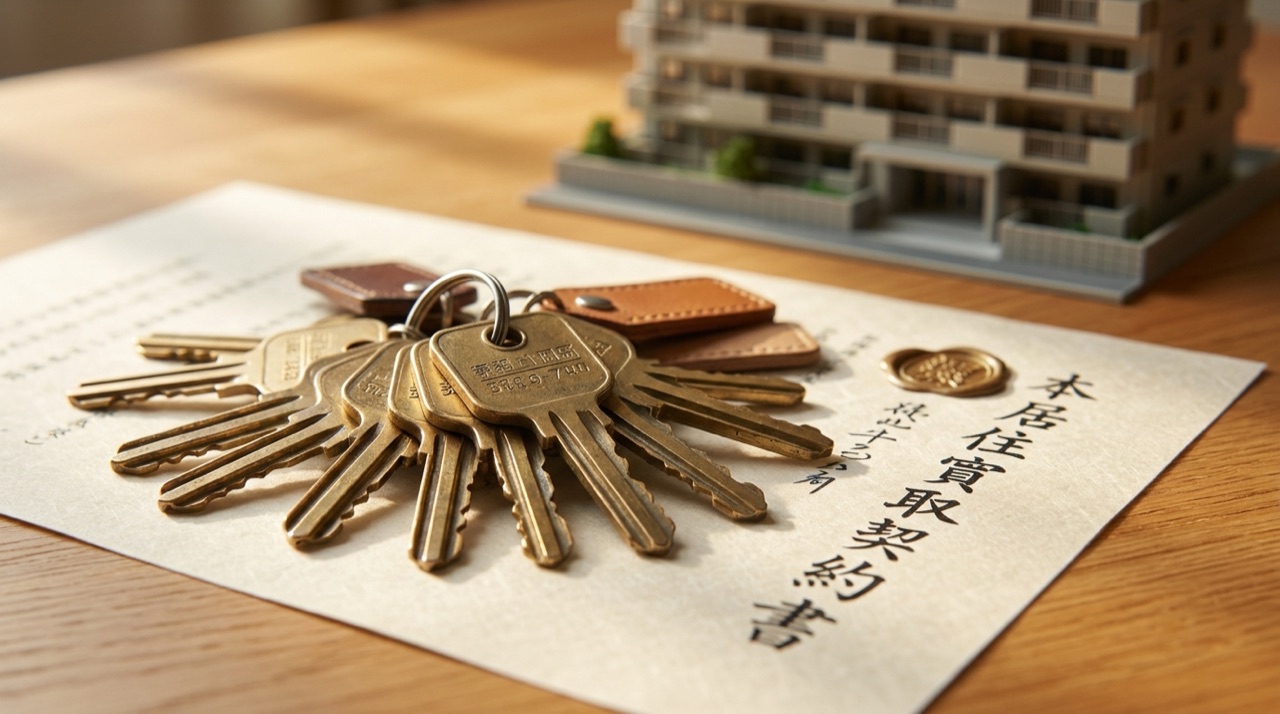
Here is the mechanic that does the heavy lifting. In Japan, property title is recorded at the Legal Affairs Bureau (the Houmukyoku — the national land and property registry), and it is centralized and publicly searchable. Before you close, you or your lawyer can pull the registry record for a specific property and read, in black and white, who owns it and what is attached to it — mortgages, liens, seizures, prior claims.
This is not a small convenience. In a lot of Asian markets, the single biggest way foreigners lose money is not a market crash — it is title. Nominee structures where someone else’s name sits on the deed. “Clean” titles that turn out to carry an undisclosed lien. Outright fraud where you buy something the seller never fully owned. The centralized, checkable registry is the structural reason those failure modes are far rarer in Japan. You can do real due diligence instead of trusting a handshake.
One honest qualifier: a registry record is a powerful tool, not a magic wand. You still want a competent licensed agent and a judicial scrivener (the specialist who handles the registration transfer) to read it properly and complete the transfer cleanly. But the data is there, it is official, and it is yours to check. In a lot of places, it simply isn’t.
Rule of law, ranked — not just asserted
Anyone can claim their market is “safe.” Japan has the ranking to back it. On the 2025 World Justice Project Rule of Law Index, Japan sits 15th of 143 countries, with a score around 0.78, and 15th of 51 among high-income economies (directional, as of writing). Translated into owner terms: contract enforcement and property rights here are at a level a foreign buyer can genuinely rely on, not hope for.
Rule of law is the invisible layer underneath the visible registry. The registry tells you who owns the property today. Rule of law is what guarantees that record will be honored tomorrow — that if a dispute arises, courts apply consistent rules, and that the state itself is bound by those rules rather than floating above them. For a long-hold asset like real estate, that second part matters more than almost anything on the listing sheet.
This is the quiet edge that doesn’t show up in a yield calculation but shows up in every year you hold the asset without a nasty surprise.
One of the safest places on the planet to own anything
Physical safety underwrites financial safety more than people admit. Japan’s homicide rate runs around 0.36 per 100,000 people — roughly 14 times lower than the United States — and Tokyo’s sits near 0.3, making it one of the safest megacities anywhere (directional, as of writing). Japan also ranks among the world’s top dozen on the 2025 Global Peace Index, a broad read on political and social stability.
Why should a property buyer care about crime stats and a peace index? Because they are the leading indicators of the things that wreck long-term real estate value: social unrest, capital flight, neighborhoods that hollow out, the slow erosion of the institutions that protect ownership. A safe, stable, low-conflict society is the ground a long-hold investment stands on. In Tokyo, that ground is about as solid as it gets. Tenants want to live there, families want to stay, and demand for prime stock doesn’t evaporate in a crisis — it concentrates.
The capital is already voting
This isn’t a forecast. It is happening. In April 2025, a record ~8.21 trillion yen (roughly $56.6 billion) flowed into Japanese stocks and bonds — the largest monthly figure since tracking began in 1996. On the property side specifically, foreign purchases in the first half of 2025 topped 1 trillion yen, also a record. Overseas buyers now account for around 27% of transactions nationwide, and up to roughly 40% of new apartment sales in the central Tokyo wards of Chiyoda, Shibuya, and Minato — the most liquid prime stock in the country.
Now set that against Hong Kong. Home prices there are down roughly 25–30% from their 2021 peak, against a backdrop of eroding autonomy — the 2020 National Security Law and the 2024 Safeguarding Ordinance. That is not an abstract risk; it is political risk repricing real property in real time. Capital that once treated Hong Kong as Asia’s safe vault is now looking for a new one, and a large share of it is landing in Tokyo and Singapore.
The contrast is the whole thesis in one frame. One market is showing you what happens when the rules change overnight. The other is showing you what decades of continuity are worth. The flows tell you which one global money believes.
Honest caveat: concentrated foreign demand in three wards is a strength and a watch-item. It deepens liquidity in the best stock, but it also means prime central pricing is increasingly set by the same global buyers — so don’t assume those specific submarkets are immune to sentiment swings.
How to act on a safe-haven thesis
If capital preservation is your goal, the move is not to chase the cheapest yield or the flashiest new tower. It is to buy liquid, verifiable, prime stock in a jurisdiction where the deed holds. Here’s the practical path:
- Define the job. If this is wealth you want to protect rather than aggressively grow, accept the lower yield as the price of safety and screen for liquidity and title clarity first.
- Start with the wards. The central, foreign-favored wards offer the deepest resale liquidity — the trait that matters most for a defensive asset. Compare them honestly on our wards overview before you fall for a single listing.
- Verify before you commit. Insist on the registry record from the Legal Affairs Bureau and have a judicial scrivener and licensed agent read it. Clean title is checkable here — so check it. Our glossary explains the terms you’ll meet at closing, from reikin (a non-refundable “key money” payment to the landlord) to the registration transfer.
- Run the numbers cold. Use our tools to model total cost and net hold economics, and our compare page to weigh Tokyo against the alternatives you’re actually considering.
The boring superpower only works if you use it. The registry, the rule of law, the stability — they are sitting there, available to any buyer willing to do the diligence. The capital already moving into Tokyo figured that out. Your next step is simple: pick the ward, pull the title, and verify the safe haven for yourself before the window narrows further.