INSIDER TAKE
Why the World Keeps Underestimating Tokyo
The global narrative says Japan is in decline. The on-the-ground reality in Tokyo says otherwise — and the gap between the two is where the opportunity sits.
On this page 12
- The Narrative Japan Inherited, and Why It Stuck
- What a 30-Year-Low Yen Actually Means for a Foreign Buyer
- Tokyo Is Not Shrinking. It Is Sorting.
- Near-Zero Rates, and What That Means for Leverage
- Record Inbound Demand and the Tourism Structural Shift
- The Boring Superpower: Rule of Law and Clean Title
- Clean title you can actually verify
- Rule of law, ranked — not just asserted
- The capital is already voting
- Where the Bears Have a Point
- How to Act on a Safe-Haven Thesis
- FAQ
TL;DR: Everyone knows Japan is “declining” — shrinking population, debt-to-GDP over 200%, the lost decades. But Tokyo is not Japan in the aggregate. The city is densifying, rents are rising for the first time in a generation, foreign capital is arriving at a record pace, and the yen gives foreign buyers a pricing advantage that has not existed in living memory. Underneath all of it sits the boring superpower — a clean, centrally registered title and a top-15 rule-of-law ranking — that makes Tokyo Asia’s real safe haven for capital fleeing riskier markets. The world is reading the wrong chart.
There’s a building in Minato Ward that sold in 2012 for roughly 400 million yen. At the 2012 exchange rate, that was about 5 million USD. The same building recently traded at 600 million yen — a 50% gain in yen terms. At today’s exchange rate, that’s about 4 million USD. The buyer in 2024 paid less in dollars for a more valuable asset.
That sentence is worth sitting with.
The Narrative Japan Inherited, and Why It Stuck
In 1989, Japan’s stock market peaked at a level it would not revisit for three and a half decades. Land in the Ginza district was valued, at the bubble’s apex, at more per square foot than anywhere else on earth. The Nikkei collapsed. Property collapsed harder. The 1990s became the template for everything the Western financial press would write about Japan for the next thirty years: deflation, demographic doom, zombie banks, a government propping up an economy too proud to restructure.
That story is not wrong. It’s just frozen in 1998.
The analysts who wrote those pieces moved on to other beats. The narrative stayed. And narratives — especially ones that feel cosmically confirmed by Japan’s surface statistics — are extraordinarily hard to update. Japan’s total population is falling. Public debt is eye-watering. The birth rate is low. All true. None of it tells you what is happening inside the city limits of greater Tokyo, which contains roughly 37 million people and is by most measures the largest functioning metropolitan economy on the planet.
From the desk — On the ground the gap is almost physical: the offshore buyers I talk to lead with the decline headlines while listings in the core wards keep tightening and rents keep nudging up. The ones who close are the patient few who came to look at the actual block, the actual commute, the actual vacancy rate, rather than the country-level chart everyone else is reading.
What a 30-Year-Low Yen Actually Means for a Foreign Buyer
For most of its post-bubble history, the yen traded somewhere between 100 and 120 to the dollar. In recent years it has spent extended periods above 150. For a buyer earning in dollars, euros, or Australian dollars, that is a discount of 25–35% on any asset priced in yen, all else equal.
This is not a subtle tailwind. This is the kind of pricing dislocation that only appears a few times in a generation, and it applies equally to a one-room apartment in Nakameguro and a six-unit building in Shinjuku. The asset is cheaper in real terms than it has been since before many of today’s buyers were born.
The counterargument — that the yen could stay weak indefinitely, eroding returns on exit — is legitimate and worth taking seriously. But it cuts both ways. Rental income collected in yen and converted back at a favorable rate during a period of yen strength becomes a yield story with a bonus attached. And if the yen normalizes toward its historical range, the capital gain on exit is almost automatic.
Tokyo Is Not Shrinking. It Is Sorting.
Japan’s rural prefectures are losing population at an alarming rate. Small cities in Tohoku, in Shikoku, in the Chugoku region — these are places where akiya, the famous “vacant homes,” pile up by the hundreds of thousands. That’s a real phenomenon and a genuine policy challenge.
Tokyo is doing the opposite. Domestic migration from rural Japan into the capital metro area has been relentless for decades and shows no sign of stopping. Tokyo absorbs population from the rest of the country even as the country’s total headcount falls. At the same time, inbound immigration — still small by OECD standards but growing fast — disproportionately concentrates in Tokyo and Osaka.
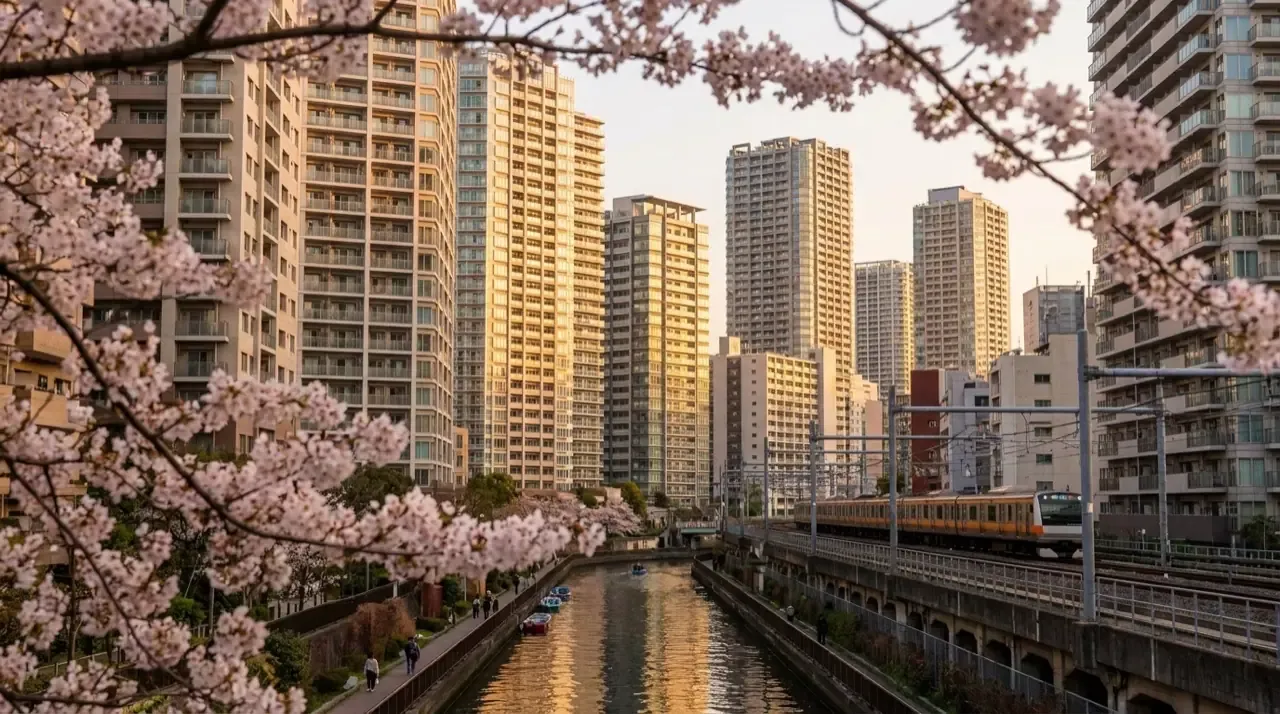
The city is also densifying vertically. Tower developments along rail corridors have added tens of thousands of units in areas that barely existed twenty years ago. Shibaura, Toyosu, parts of Musashikosugi — these were industrial or low-density zones. They are now legitimate residential neighborhoods with cafes and international schools and very short commutes to the central business district.
The demographic story that matters for property investors is local, not national. Japan’s population in aggregate is falling. Tokyo’s population is holding. The ratio of new housing supply to actual demand in the core wards is tighter than the aggregate numbers suggest.
Near-Zero Rates, and What That Means for Leverage
Japan’s central bank has held rates near zero for so long that low borrowing costs have become background noise — easy to overlook precisely because they have existed for so long. For a Japanese resident, mortgage financing at sub-2% is normal. For a foreign investor accessing Japanese bank lending, the numbers are slightly higher, and qualification is genuinely difficult (more on that later). But the underlying cost of capital in this market remains among the lowest available anywhere in the developed world.
Low rates compress cap rates. They also make cash-flow-positive property achievable at price points that would be impossible in Sydney, London, or Miami. A well-located small apartment building in the Tokyo commuter zone, bought at the right price, can still produce a gross yield in the 5–7% range. After financing costs at Japanese rates, that yield survives contact with reality. That is not a common condition in 2024’s global property market.
Record Inbound Demand and the Tourism Structural Shift
Before 2019, Japan received roughly 31 million foreign visitors per year. Tourism had been growing explosively for a decade. Then the pandemic removed it entirely.
What happened on reopening was not a simple recovery. Visitor numbers surged, spending per visitor surged harder, and the weak yen made Japan a genuine bargain for foreign travelers in a way that had not existed for years. Cities saw occupancy rates in short-term rentals hit levels that overwhelmed supply. The minpaku regulatory framework — Japan’s licensing system for short-term rentals — had deliberately constrained supply. The demand came back faster than supply could respond.
This has real implications for property investors with operational ambitions. The structural argument for Tokyo and Kyoto short-term rental demand is not a trend story. It is a function of Japan’s cultural weight, its safety, its food, and a yen that makes the country accessible to a wider income bracket of global traveler than almost any comparable destination.
Related reading: Early, Not Late: Why the Japan Trade Has Years of Runway Left Into the 2030s.
The Boring Superpower: Rule of Law and Clean Title
Most pitches for foreign real estate lead with a number: a rental yield, a price-appreciation forecast, a “this market is about to pop” story. Tokyo’s pitch is different, and you should hear it clearly before you wire any money. The thing you are buying here is not a double-digit return. It is the near-certainty that the asset will still be yours, on the same terms, in twenty years — and that nobody can quietly take it from you.
That sounds dull. It is dull. It is also the single hardest thing to find in Asian real estate, and the reason capital is moving. When money flees an unstable market, it is not chasing the highest yield. It is chasing the place where the deed means what it says and the government will not rewrite the rules between Tuesday and Wednesday. If your goal is capital preservation — parking wealth somewhere it cannot be inflated, expropriated, or litigated away — Tokyo belongs at the top of a very short list. Prime yields are compressed precisely because so many people want the safety. You are paying for the safety. That is the trade.
From the desk — The buyers who lose money in the riskier parts of Asia almost never lose it to a price crash, in my experience, they lose it to title they could not verify, and that is exactly the failure mode I rarely see here. When a registry record from the Legal Affairs Bureau puts the liens and the true owner on the table before anyone signs, you can watch the relief land on a buyer who has been burned by a handshake market before.
Clean title you can actually verify
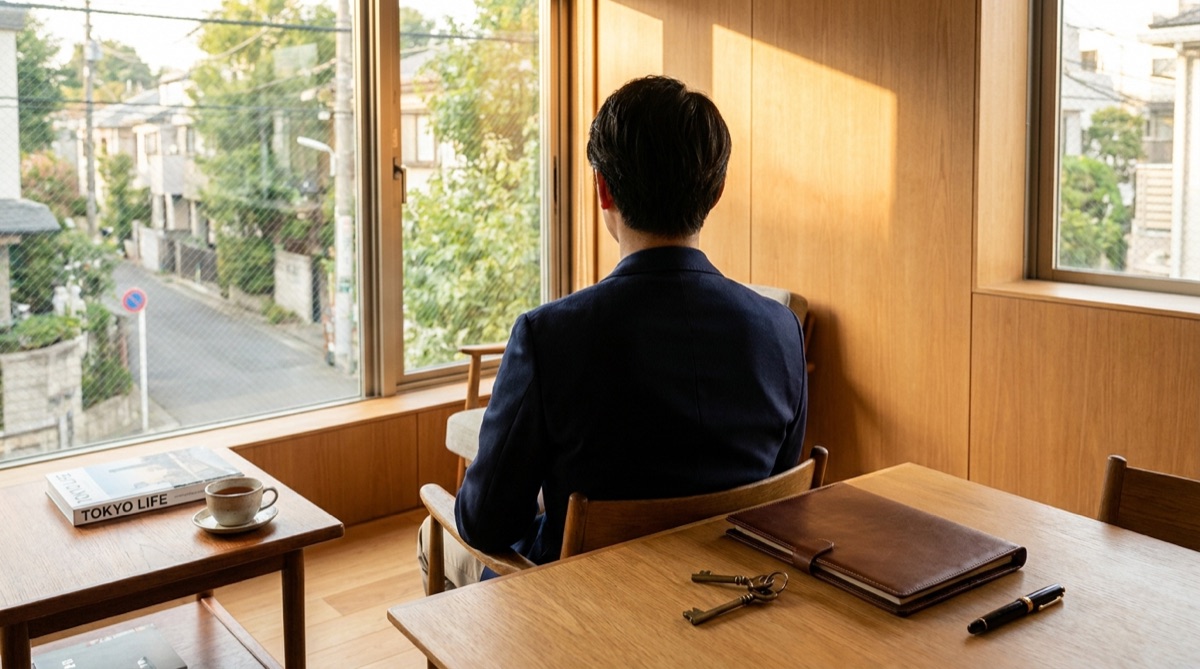
Here is the mechanic that does the heavy lifting. In Japan, property title is recorded at the Legal Affairs Bureau (the Houmukyoku — the national land and property registry), and it is centralized and publicly searchable. Before you close, you or your lawyer can pull the registry record for a specific property and read, in black and white, who owns it and what is attached to it — mortgages, liens, seizures, prior claims.
In a lot of Asian markets, the single biggest way foreigners lose money is not a market crash — it is title. Nominee structures where someone else’s name sits on the deed. “Clean” titles that turn out to carry an undisclosed lien. Outright fraud where you buy something the seller never fully owned. The centralized, checkable registry is the structural reason those failure modes are far rarer in Japan. You can do real due diligence instead of trusting a handshake.
One honest qualifier: a registry record is a powerful tool, not a magic wand. You still want a competent licensed agent and a judicial scrivener (the specialist who handles the registration transfer) to read it properly and complete the transfer cleanly. But the data is there, it is official, and it is yours to check. In a lot of places, it simply isn’t.
Rule of law, ranked — not just asserted
Anyone can claim their market is “safe.” Japan has the ranking to back it. On the 2025 World Justice Project Rule of Law Index, Japan sits 15th of 143 countries, with a score around 0.78, and 15th of 51 among high-income economies (directional, as of writing). Translated into owner terms: contract enforcement and property rights here are at a level a foreign buyer can genuinely rely on, not hope for.
Rule of law is the invisible layer underneath the visible registry. The registry tells you who owns the property today. Rule of law is what guarantees that record will be honored tomorrow — that if a dispute arises, courts apply consistent rules, and that the state itself is bound by those rules rather than floating above them. For a long-hold asset like real estate, that second part matters more than almost anything on the listing sheet.
Physical safety underwrites financial safety more than people admit. Japan’s homicide rate runs around 0.36 per 100,000 people — roughly 14 times lower than the United States — and Tokyo’s sits near 0.3, making it one of the safest megacities anywhere (directional, as of writing). Japan also ranks among the world’s top dozen on the 2025 Global Peace Index, a broad read on political and social stability. Crime stats and a peace index are the leading indicators of the things that wreck long-term real estate value: social unrest, capital flight, neighborhoods that hollow out, the slow erosion of the institutions that protect ownership. Tenants want to live here, families want to stay, and demand for prime stock doesn’t evaporate in a crisis — it concentrates.
The capital is already voting
This isn’t a forecast. It is happening. In April 2025, a record ~8.21 trillion yen (roughly $56.6 billion) flowed into Japanese stocks and bonds — the largest monthly figure since tracking began in 1996. On the property side specifically, foreign purchases in the first half of 2025 topped 1 trillion yen, also a record. Overseas buyers now account for around 27% of transactions nationwide, and up to roughly 40% of new apartment sales in the central Tokyo wards of Chiyoda, Shibuya, and Minato — the most liquid prime stock in the country.
Now set that against Hong Kong. Home prices there are down roughly 25–30% from their 2021 peak, against a backdrop of eroding autonomy — the 2020 National Security Law and the 2024 Safeguarding Ordinance. That is not an abstract risk; it is political risk repricing real property in real time. Capital that once treated Hong Kong as Asia’s safe vault is now looking for a new one, and a large share of it is landing in Tokyo and Singapore.
The contrast is the whole thesis in one frame. One market is showing you what happens when the rules change overnight. The other is showing you what decades of continuity are worth. The flows tell you which one global money believes.
Honest caveat: concentrated foreign demand in three wards is a strength and a watch-item. It deepens liquidity in the best stock, but it also means prime central pricing is increasingly set by the same global buyers — so don’t assume those specific submarkets are immune to sentiment swings.
Related reading: The Earthquake Fear Is Priced for 1923 — Tokyo Is Built for 2026.
Related reading: From Bubble to Bargain: The 35-Year Story of Japanese Property.
Where the Bears Have a Point
None of this is without real risk. A few things the bulls tend to underweight:
Liquidity is thin. Tokyo property is not difficult to sell, but the transaction process is slow, opaque by Western standards, and broker-dependent in ways that favor local relationships. Foreign sellers in particular can find the exit harder than the entry.
Yen risk is real. Everything discussed above about the currency discount works in reverse if the yen strengthens significantly before you sell. This is not a reason to avoid the market; it is a reason to think carefully about hold periods and hedging.
Foreign buyer financing is genuinely hard. Japanese banks are not enthusiastic lenders to non-residents. Without permanent residency or significant local income, cash or seller financing is frequently the only path. That changes the yield math considerably.
Regulation can move. Minpaku rules tightened once and could tighten again. Any strategy built on short-term rental income should be stress-tested against a scenario where that income disappears.
Tokyo’s population resilience depends on policy. If domestic migration slows or immigration policy tightens, the fundamental supply-demand dynamic shifts. This is a long-horizon risk, not an immediate one, but it deserves honest acknowledgment.
These are real constraints. They mean Tokyo rewards prepared, patient investors over tourists who read one article and wire a deposit. The opportunity is genuine; it is not easy.
How to Act on a Safe-Haven Thesis
If capital preservation is your goal, the move is not to chase the cheapest yield or the flashiest new tower. It is to buy liquid, verifiable, prime stock in a jurisdiction where the deed holds. Here’s the practical path:
- Define the job. If this is wealth you want to protect rather than aggressively grow, accept the lower yield as the price of safety and screen for liquidity and title clarity first.
- Start with the wards. The central, foreign-favored wards offer the deepest resale liquidity — the trait that matters most for a defensive asset. Compare them honestly on our wards overview before you fall for a single listing.
- Verify before you commit. Insist on the registry record from the Legal Affairs Bureau and have a judicial scrivener and licensed agent read it. Clean title is checkable here — so check it. Our glossary explains the terms you’ll meet at closing, from reikin (a non-refundable “key money” payment to the landlord) to the registration transfer.
- Run the numbers cold. Use our tools to model total cost and net hold economics, and our compare page to weigh Tokyo against the alternatives you’re actually considering.
The boring superpower only works if you use it. The registry, the rule of law, the stability — they are sitting there, available to any buyer willing to do the diligence. The capital already moving into Tokyo figured that out. Pick the ward, pull the title, and verify the safe haven for yourself before the window narrows further.
FAQ
Can foreigners legally buy property in Japan? Yes. Japan imposes essentially no restrictions on foreign ownership of real estate. There is no special visa requirement, no approval process, no minimum investment threshold. You can own freehold property as a non-resident. The friction is practical — language, banking, property management — not legal.
Is the yen weakness going to last? Nobody knows, and anyone who tells you otherwise is speculating. What is observable is that the Bank of Japan has been exceptionally slow to normalize rates relative to global peers, and that yen weakness has persisted far longer than most analysts expected. For planning purposes: model both scenarios.
What kind of yields can a foreign investor realistically expect? Gross yields on residential in central Tokyo run roughly 3–5% for high-quality assets, 5–8% for secondary locations or older stock. Net yields, after management fees, taxes, and vacancy, are meaningfully lower. Any projection that shows net yields above 6% in core Tokyo deserves hard scrutiny.
Do I need to be in Japan to manage a property? No. Property management companies in Tokyo routinely handle foreign absentee owners. Quality varies, and the management fee structure differs from what Western investors are used to. Building a relationship with a reliable manager is one of the most important early decisions.
What is the biggest mistake foreign buyers make? Buying without a local professional who works in their interest — not the seller’s. Japan’s real estate brokerage structure means the same agent frequently represents both sides of a transaction. Understanding that dynamic before you sign anything is not optional.