WARDS & MARKETS
Azabudai, Toranomon & Roppongi: Tokyo's New Trophy Core
A clear-eyed insider's map of the Mori-led super-tall cluster across Azabudai, Toranomon and Roppongi — the branded residences, international tenants, record prices, and who actually buys here and why.
On this page 7
TL;DR: Mori Building has spent three decades and roughly USD 5bn turning the strip between Azabudai, Toranomon and Roppongi into Tokyo’s single most expensive new address — three super-tall towers, Aman and Janu branding, and a 91-unit residence that reportedly logged Japan’s priciest-ever home sale. If you want a trophy asset that an international tenant or buyer instantly understands, this is now the cluster to know. Just go in clear-eyed about the yields.
What actually got built here
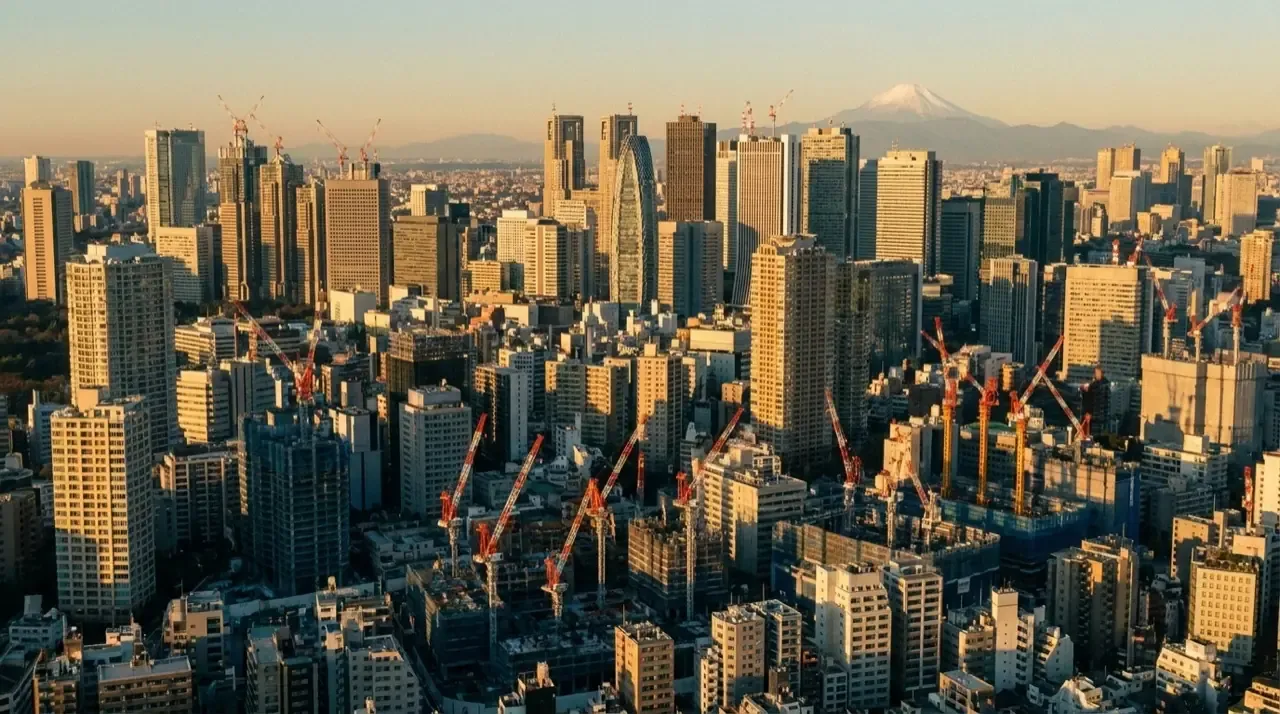
For years “central Tokyo luxury” meant Roppongi Hills and Tokyo Midtown — both Mori-era landmarks that defined Minato-ku’s high end. The new chapter sits a few hundred metres south and west, and it is denser and taller than anything before it.
Three towers anchor the cluster (heights directional, as of writing):
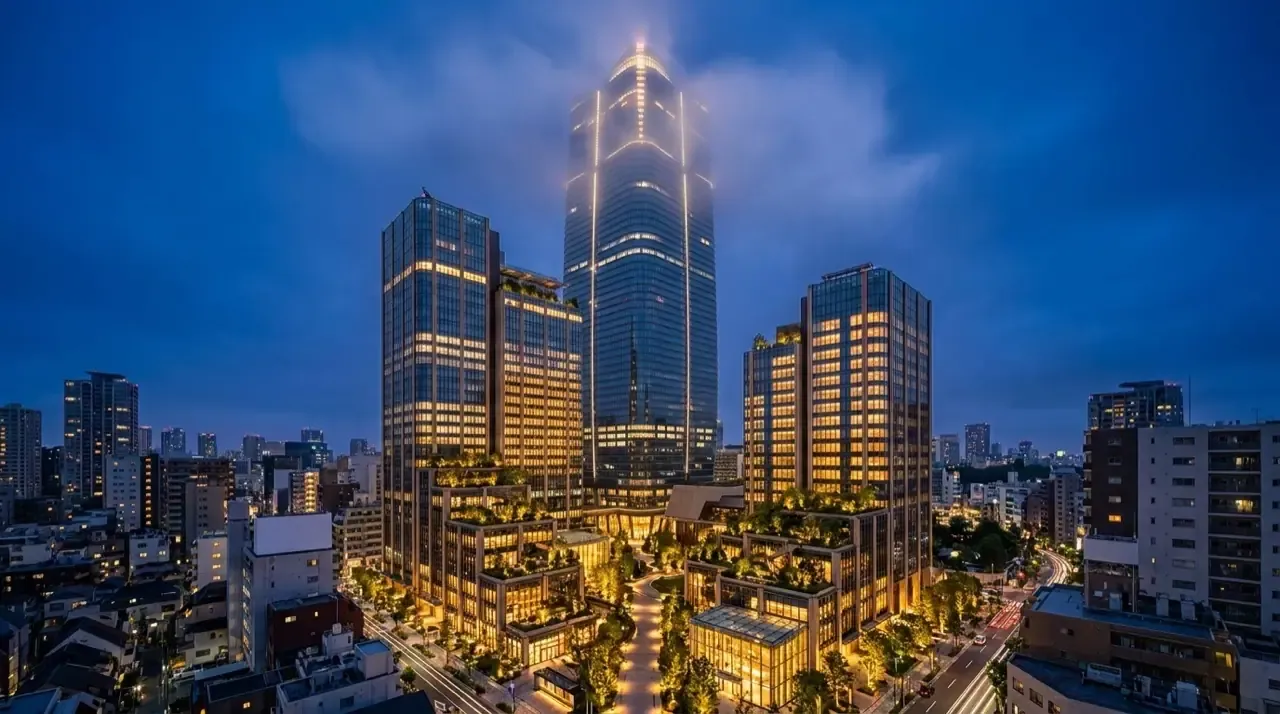
- Azabudai Hills Mori JP Tower — 325.2m, 64 floors. Japan’s tallest building, opened in 2023. Offices on the lower two-thirds, Aman Residences crowning the top.
- Toranomon Hills Station Tower — 266m, 49 floors, opened 2023. Built directly over a new Hibiya Line station entrance — you can walk from platform to lobby without stepping outside.
- Toranomon Hills Mori Tower — 255m, 52 floors, the 2014 original that started the Toranomon push.
Add the older Roppongi Hills Mori Tower (238m) a short walk east, and you have four super-talls within roughly fifteen minutes on foot. No other patch of Tokyo concentrates this much new, institutional-grade vertical real estate. Azabudai Hills alone added around 1,400 homes across Mori JP Tower, Residence A and Residence B, the last of which completed in late 2025.
This is not a scattering of nice buildings. It is a deliberately engineered “address” — green plaza at the centre, international school, art museums, a Janu hotel, clinics, and a venture-capital hub all inside the same few blocks.
From the desk — The buyers I watch hesitate here almost always hesitate on the yield, and they are right to. What I keep seeing, though, is that the ones who buy this cluster were never solving for cash flow in the first place; they want an address a banker in Singapore or Hong Kong recognizes without a map, and in my experience that legibility is what holds the resale pool deep when softer assets go quiet.
The branded-residence play
The headline product is Aman Residences, Tokyo — Aman’s first standalone branded residences anywhere, occupying the top floors of Mori JP Tower. Ninety-one apartments, a roughly 1,400 sqm spa, private dining, 24-hour concierge. They have reportedly sold out, and one unit is said to have changed hands for around JPY 20bn — directional, as of writing, but if accurate it is the most expensive home ever sold in Japan.
Below and beside it, Janu Tokyo — Aman’s younger, more social sister brand — opened its first global property here in 2024. That matters for buyers because a branded-residence pitch lives or dies on the operator. Aman and Janu are names a buyer in Singapore, Hong Kong or Los Angeles recognises instantly, which is exactly the point.
Here is the honest framing on price. The Aman penthouse benchmark has been quoted at roughly JPY 4.4m per tsubo (a tsubo is about 3.3 sqm) — directional, as of writing. Average Azabudai Hills units have traded around JPY 2bn, with smaller two-bedrooms (~70 sqm) reported in the JPY 600–800m band. For context, Minato-ku’s average new-condo unit price has pushed past JPY 600m in recent 2025 readings, and central-Tokyo new-build prices have run up more than 18% year on year. Azabudai sits at the very top of that curve, not the middle of it.
Caveat worth saying plainly: “branded” is a premium you pay on entry and may not fully recover on exit. You are buying service, certainty and a name — not a discount.
Who buys here, and why
In my experience the buyer pool for this cluster falls into four buckets:
- Overseas individuals wanting a Tokyo trophy — often from Hong Kong, Singapore, Taiwan, mainland China and the US, drawn by the weak yen, freehold ownership with no foreign-buyer restrictions, and a name their peers recognise.
- Relocating executives and family offices who want turnkey, serviced, English-speaking living and will pay for zero friction.
- Asian HNW buyers treating Tokyo as a stability hedge — Japan’s rule of law, political calm and currency diversification matter more to them than yield.
- Corporate and institutional lessees taking units for senior expat staff on multi-year leases.
The common thread: these are buyers for whom the asset’s legibility — instantly understood by a banker, a tenant, a future buyer — is worth more than squeezing the last basis point of return.
The international-tenant engine
Trophy residential only holds its value if the surrounding economy keeps importing high earners. This cluster is purpose-built to do exactly that. Mori JP Tower offers floor plates around 4,800 sqm — among the largest in Japan — aimed squarely at global occupiers, and the complex hosts names including Deutsche Bank, Deloitte and others, plus the Tokyo Venture Capital Hub gathering roughly 70 domestic and international VC firms under one roof.
Why a buyer should care: offices full of well-paid international staff are your future rental demand and your future resale pool. An address that corporate HR departments already know how to relocate people into is an address that stays liquid. The international school and medical facilities on-site close the loop for families — the single hardest tenant segment to serve in Tokyo.
The numbers you can’t ignore: yield
Be honest with yourself before you fall for the view. Gross rental yields on these ultra-prime units run roughly 2–3% — and at the very top end, below 2%. A JPY 1bn apartment renting at JPY 1.5–2m a month pencils out near 1.8–2.4% gross, before management fees, taxes and the not-trivial monthly charges that come with branded service.
That is a capital-preservation-and-appreciation play, not a cash-flow play. If you need income, this cluster is the wrong tool — you’d look to smaller units in other wards or run the math yourself in our tools. If you want a hard asset in a hard currency that holds attention through cycles, the thin yield is the price of admission. Run a clean buy-vs-elsewhere comparison before committing — our compare view exists for exactly this decision.
A quick map of the cluster
To read it as a map rather than a list:
- Azabudai — the residential summit. Aman, Janu, the tallest tower, the greenest plaza, the highest prices. Buy here for the trophy.
- Toranomon — the business spine. Station Tower’s metro-integrated access and large offices make it the connectivity and corporate-demand core. Buy nearby for tenant depth.
- Roppongi — the established anchor. Roppongi Hills and Midtown gave this whole district its luxury DNA and still offer comparatively more resale track record. Buy here for proven liquidity.
Three flavours of the same trophy thesis, walkable to one another.
Your next step
If this cluster fits your goal — a recognisable, liquid, hard-currency Tokyo asset you can hold through cycles — the move is not to chase a sold-out Aman unit. It is to position around the cluster: resale stock in the older Mori towers, new units in Residence A and B, or comparable trophy product in adjacent Roppongi and Toranomon blocks where entry prices are a notch lower and yields a notch kinder.
Start by deciding which of the three sub-areas matches your priority — trophy, tenant depth, or proven liquidity — then pressure-test one specific building against a second ward using our compare tool. Bring me a shortlist of two or three buildings and a number, and we can tell you in an afternoon whether the premium is worth paying. That is the difference between buying a view and buying an asset.