WARDS & MARKETS
Toyosu, Ariake & the Bay: Tokyo's Waterfront Reinvention
An honest insider's map to Tokyo's bay-area tower-mansion belt — Toyosu, Ariake, Harumi and the Harumi Flag legacy. Real numbers on price, yield, family demand, and the trade-offs of waterfront tower living vs the central wards.
On this page 6
TL;DR: Tokyo’s bay area — Toyosu, Ariake, Harumi — is where you buy new, large, and waterfront for roughly 30-40% less per square meter than the central wards, and where families actually want to live. Prices here have nearly doubled in five years (Toyosu hit about 1.84m yen/sqm in 2025, directional, as of writing), and the Olympic-legacy Harumi Flag has already proven the demand. The honest catch: reclaimed-land liquefaction risk and weaker train access mean this is a lifestyle-and-growth play, not a trophy-address play.
Why the bay even matters now
For decades, foreign buyers were told the only Tokyo worth owning was the central trio — Minato, Chiyoda, Chuo. That’s still where the trophy money goes. But the action, the new supply, and the family demand have moved east to the water.
Here’s the structural reason: central Tokyo barely builds anymore. New-condo supply keeps shrinking, which is exactly why existing-condo prices are climbing faster than new ones. The bay area is the opposite — it’s Tokyo’s last large-scale blank canvas. Koto ward, which holds Toyosu and Ariake, has the newest average building stock in the entire city (directional, around 4 years old as of writing). If you want a genuinely new tower with modern earthquake engineering, big floor plates, and resort-grade amenities, you buy on the water. You can’t get it in Azabu at any sane price.
So this isn’t a discount bin. It’s a different product: newer, bigger, greener, and aimed squarely at families rather than at people buying an address.
From the desk — The buyers I watch hesitate on the bay almost always hesitate on the wrong thing. They fixate on the lack of a prestige postcode, then skim past the soil report and the actual station walk, which are the two lines that genuinely decide how a bay tower trades later. Year after year the families who buy here for space and newness are calmer about reclaimed-land risk once they read the seismic spec than the speculators who never opened it.
The map: who’s who on the water
Think of the bay belt as four distinct neighborhoods, not one blob.
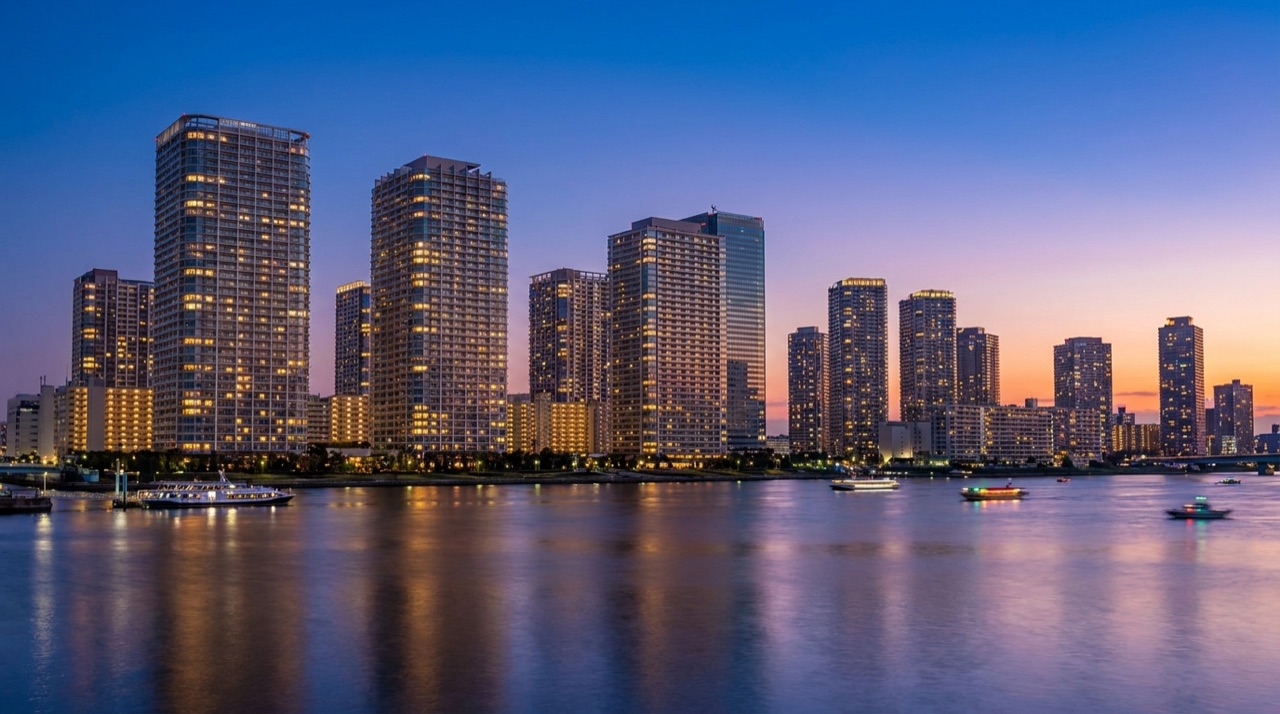
Toyosu (Koto-ku). The mature anchor. It has the train line everyone else wishes they had — the Yurakucho Line gets you to Ginza and Otemachi in roughly 20 minutes — plus the famous Toyosu Market (the fish market that replaced Tsukiji), the teamLab Planets museum, and the LaLaport mall. Toyosu is the most liquid, most proven bay market. It logged the highest transaction count of any rising-price district in the 23 wards in 2025, and prices rose roughly 88% over five years to about 1.84m yen/sqm (directional, as of writing). When foreigners ask me where to start on the bay, this is usually the answer.
Ariake (Koto-ku). Younger, more spacious, more “planned city.” Wide streets, Ariake Garden (a huge mall-plus-hotel-plus-spa complex), parks, and waterfront promenades. Towers here lean hard into family amenities — kids’ rooms, nurseries, sky lounges, guest suites. The trade-off is transport: Ariake leans on the Yurikamome and Rinkai lines, which are fine but not the Yurakucho Line. You’re buying space and newness over commute speed.
Harumi (Chuo-ku). This is the interesting one, because Harumi is technically in Chuo — a central ward — but functions like a bay island. It’s home to Harumi Flag, the converted Olympic Village (more below). Harumi’s blessing and curse is the same fact: no train station on the island. The nearest, Kachidoki, is a 17-to-22-minute walk, bridged for now by bus and BRT.
Shinonome / Tatsumi. The quieter, value end. Less glamour, lower prices, solid family stock. Worth a look if you want bay-area newness without paying the Toyosu premium.
Harumi Flag: the legacy asset that actually delivered
If you read one bay-area case study, make it this. Harumi Flag is the repurposed 2020 Olympic Village — Japan’s largest condominium complex, around 5,600 units across 24 buildings on roughly 18 hectares. Skeptics (me included, early on) doubted that anyone would want to live on a train-less island. The market answered.
Demand at launch was frenzied — some units drew well over a hundred applications each, because the developers priced the initial release below what comparable new Tokyo stock was fetching. Occupancy began in January 2024, and the population is filling toward roughly 12,000 residents. By mid-2024, an NHK investigation found nearly 20% of one tranche of units (about 491 of 2,690) were already being rented out or resold for investment — a blunt signal that buyers saw flip-and-rent upside, and got it.
The honest caveat: Harumi Flag’s early gains came partly from that deliberately low launch price. Don’t assume the next bay project repeats a one-off Olympic discount. But as a proof of concept — that Tokyo families and investors will absolutely buy a train-less waterfront island if the product and price are right — Harumi Flag settled the argument.
The numbers, plainly
Let me give you the comparison that actually matters, central wards vs the bay (all directional, as of writing):
- Per-square-meter price. Central premium wards (Minato, Chiyoda, Chuo core) run roughly 2.3-4.5m yen/sqm. Toyosu sits around 1.84m yen/sqm. You’re paying meaningfully less per meter on the bay — and getting newer, bigger units for it.
- Rent. A 1LDK runs about 270,000-360,000 yen/month in Minato, 220,000-290,000 in Chuo, and 190,000-240,000 in Koto. Lower rent, but also a much lower entry price.
- Yield. The bay is not Tokyo’s top-yield zone — that’s the cheaper east, like Sumida/Kinshicho near 5%+ gross. But the bay beats the trophy wards on pure yield. Azabu and Aoyama are gorgeous places to own and lousy places to collect rent; the capital required there rarely pencils out against income. The bay’s newer towers and steady family demand support rent well enough to make the math defensible.
For the full ward-by-ward picture, see our ward guides and run your own numbers on the yield and cost tools. If you want a side-by-side, the compare view is built for exactly this central-vs-bay decision.
The honest pros and cons of bay tower living
I won’t sell you the brochure. Here’s the real ledger.
In favor:
- New construction with current seismic engineering, big floor plans, and amenities (gyms, lounges, kids’ spaces, concierge) that central pre-war and 1980s stock simply can’t match.
- Genuine family appeal — parks, malls, waterfront, schools, stroller-friendly wide streets. This is demand that doesn’t depend on tourists or speculators.
- Lower entry price per meter than the central wards, with strong recent appreciation and high transaction liquidity in Toyosu specifically.
Against — and these are real:
- Liquefaction risk. This is reclaimed land. Parts of Koto saw visible liquefaction in the 2011 quake, and hazard models flag the bay as higher-risk than the firmer plateau under Minato or Chiyoda. Modern towers here are piled to bedrock with reinforced foundations specifically to handle it — that’s not marketing, it’s why the building boom concentrated here — but you are buying soil risk that central buyers aren’t. Read the building’s seismic spec before you sign.
- Transport asymmetry. Toyosu is well-served; Harumi and parts of Ariake are not. A train-less island is fine until it isn’t. Check the actual walk to the actual station, not the brochure’s “area access.”
- Tower-specific costs. High-rise reserve funds and management fees for elevators, facades, and amenities are not trivial and tend to rise as buildings age. Budget for them.
- It’s not a trophy address. If your goal is the prestige of a Minato postcode, the bay won’t give you that. It gives you space, newness, and growth instead.
Who should buy here
Be honest with yourself about which buyer you are. If you want the scarcest, most prestige-resilient central trophy, stay in the central wards and accept thin yields. If you want a new, large, family-grade home or a rentable modern asset at a friendlier price per meter — and you can stomach reclaimed-land risk that’s engineered against but not erased — the bay is one of the best risk-adjusted entries in Tokyo right now.
The waterfront has already proven its demand: Harumi Flag filled, Toyosu’s transaction volume leads the city, and families keep choosing the water. The question isn’t whether the bay works. It’s whether the specific tower, the specific station walk, and the specific seismic spec work for you.
Your next step is simple: pick two or three towers across Toyosu, Ariake, and Harumi, pull their real per-meter prices and management fees, check each one’s liquefaction zone and station walk, and run them through the compare tool against a central-ward equivalent. The bay rewards buyers who do that homework — and quietly penalizes the ones who buy the view and skip the soil report.
Sources: Japan Property Central — Harumi Flag, Harumi Flag — Wikipedia, note.com — Top 10 rising-price districts in Tokyo, PLAZA HOMES — Ariake/Shinonome/Daiba area guide, PropertyAccess — Tokyo 23 wards price per sqm 2026, E-Housing — Tokyo disaster risk by ward, Bamboo Routes — Tokyo rental yields 2026, PLAZA HOMES — Tokyo rent prices 2025.