BUYING & FINANCE
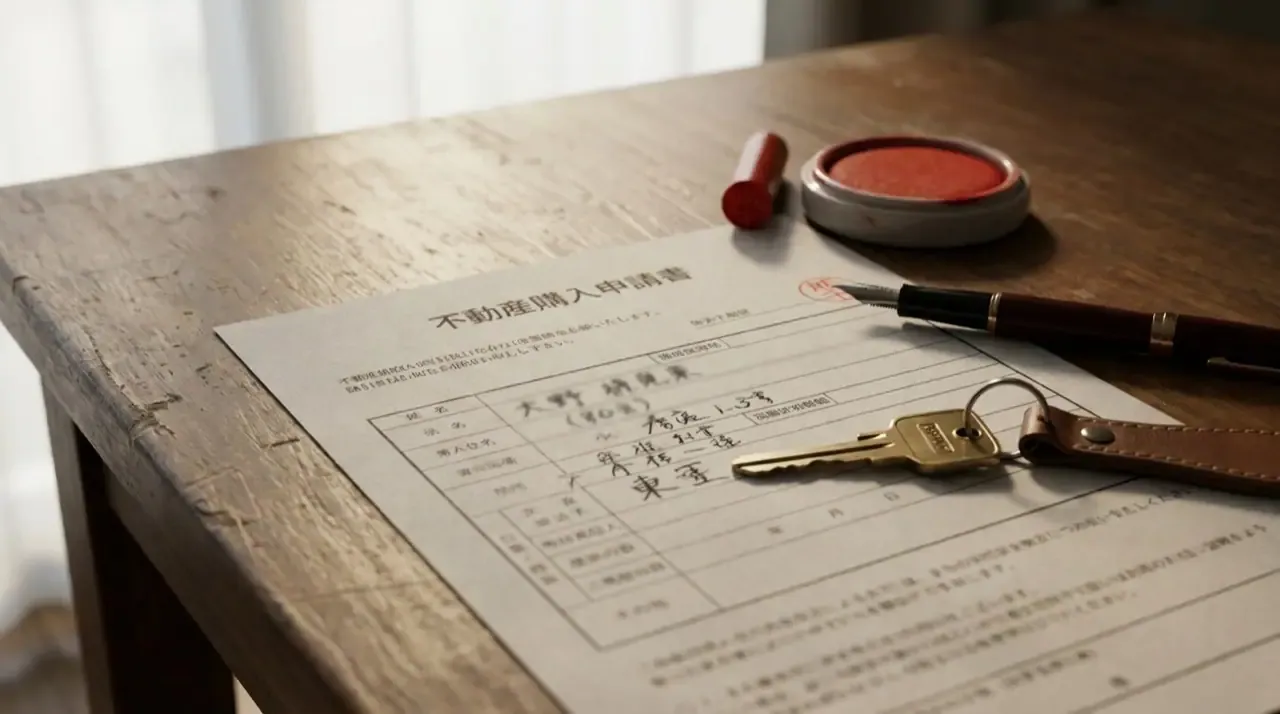
Making an Offer in Japan: Purchase Application, Price Negotiation, and What's Actually Binding
A Tokyo-based insider explains how Japan's offer letter works, how to negotiate price, and what's binding before you sign the purchase contract.
On this page 11
- What exactly is a purchase application and what does it contain?
- What does Japanese law actually say about the letter?
- What each stage commits you to
- Extra protection when the seller is a licensed dealer
- How does price negotiation actually work in Japan?
- The market you are negotiating in, late 2026
- What happens if multiple offers come in at the same time?
- What conditions can you include in a purchase application?
- What does “verbally accepted” actually mean?
- Where this goes wrong
- FAQ
TL;DR: You make an offer in Japan by submitting a purchase application (kaitsuke shomeisho) through an agent, stating your price and conditions. It normally does not create a sale, the seller can choose another buyer, and you can normally withdraw without paying anything. What binds both sides is the purchase contract, which is signed with a deposit after the statutory disclosure. “Normally” matters: Japanese law requires no special form for a contract, so the wording of your letter and your conduct afterwards still count.
One foreign buyer submitted a purchase application at full asking price, heard nothing for five days, then learned the property sold to someone else — same price — because the other buyer’s agent had a better relationship with the seller’s agent.
He was furious. He felt deceived. He wasn’t. He just didn’t understand how Japanese offers work.
Japan’s offer process rewards relationships, speed, and certainty signals. Price helps. It’s not the only variable.
What exactly is a purchase application and what does it contain?
It’s a short letter expressing your intent to purchase. Typical contents:
- Buyer name and contact details
- Property address
- Intended purchase price
- Intended settlement date
- Any conditions (financing, inspection, etc.)
- Expiry date of the offer
- Buyer signature
No statute prescribes the form, and your agent’s template will vary. Some are formal letters; some are simple fill-in documents.
From the desk — The buyers I watch lose properties are rarely outbid on price; they are outpaced on certainty. In the offers I have seen play out, sellers here lean toward the cleanest terms and the agent they already trust, and a buyer who signals eagerness or stacks on contingencies quietly hands away the leverage they thought price was buying them.
What does Japanese law actually say about the letter?
“Not legally binding” is the usual shorthand. It is right in most cases, but it is a conclusion courts reach on the facts, not a rule written into the law. Four points are worth knowing.
A contract needs no paperwork in principle. Civil Code Article 522 says a contract forms when an offer stating the contract’s content is accepted, and that no writing is required unless a law says otherwise. So the protection is not that the letter is informal. The protection is that the parties have not yet reached a definite agreement.
Courts look for a definite agreement on the basic terms. In a Tokyo District Court case of 25 December 2014, a signed agreement on a sale did not create a contract because the price was not fixed and the settlement date and other main terms were left open. The case note from RETIO, the real estate transaction research foundation, adds that exchanging a purchase application and a seller’s acceptance letter does not by itself establish a sale when firm agreement on basic elements such as performance dates is missing. That reasoning turns on the facts. A letter with every term settled carries more risk than one that says a contract will follow.
An offer with a deadline can be irrevocable if it is a true legal offer. Civil Code Article 523 says an offer that sets a period for acceptance cannot be withdrawn during that period, unless the offeror reserved the right to withdraw. Article 525 gives similar protection for a reasonable time when no period is set. If you want to remove doubt, ask your agent to state in the letter that it is non-binding, that a sale arises only on a signed contract, and that you may withdraw before then.
Walking away is free in general, not in every case. Each side may normally end negotiations and bear its own costs. A party who leads the other to believe a contract is certain, knowing the other will spend money on that belief, can owe damages for those costs. RETIO’s note on a Tokyo District Court ruling of 26 January 2022 states this rule, citing a Supreme Court judgment of 18 September 1984. In that case a buyer withdrew after a purchase application, and the seller claimed about ¥4.07 million paid to move out tenants. The claim failed because contract terms and dates were still open. The practical lesson is to avoid telling a seller “it’s definitely done” and then letting them spend money.
What each stage commits you to
| Stage | Can you leave? | What it can cost | Rule |
|---|---|---|---|
| Purchase application | Normally yes | Normally nothing. Any money your agent holds must come back if you withdraw. | Enforcement Regulations Art. 16-11(ii) bars licensed agents from refusing to return held funds when an offer is withdrawn |
| Seller’s oral or written acceptance | Normally yes | Normally nothing, with the damages exception above in late-stage cases | Civil Code Arts. 522-523 and the cases above |
| Important Matters explanation | Yes, if no contract is signed | Nothing for the disclosure itself | Brokerage Act Art. 35: must be explained before the contract is formed |
| Contract signed, deposit paid | Only by giving up the deposit, until the other side starts performing | The deposit (buyer). The seller must tender double. | Civil Code Art. 557 |
| After performance has started | Only under the contract’s terms | Contract damages or penalty | The contract, and Art. 38 below when the seller is a licensed dealer |
This table is a general guide, not advice on your document. Contract clauses can change the deposit stage, so read yours with our contract guide.
Worked example (inputs are illustrative). On a ¥60 million purchase with a 10% deposit, the buyer’s exit before the seller starts performing costs ¥6 million, the deposit. The seller’s exit costs tendering ¥12 million: the deposit back, plus the same amount again.
Extra protection when the seller is a licensed dealer
Developers and resale companies are licensed dealers (takken gyosha), and the Real Estate Brokerage Act limits what they can impose on you:
- Deposit cap. Art. 39: no more than 20% of the price (¥12 million in the example). Whatever it is called, the deposit works as a cancellation deposit, and terms worse for the buyer are void.
- Damages cap. Art. 38: pre-agreed damages and penalties together cannot exceed 20% of the price.
- Cooling-off. Art. 37-2: if you applied or signed outside the dealer’s office or similar designated place, you can withdraw or cancel in writing. The right ends 8 days after you are told about it in the prescribed way, or once you have taken delivery and paid in full.
None of these caps apply in the same way to a private individual selling directly, so check who the seller is on the listing and the register.
How does price negotiation actually work in Japan?
Through agents, not directly. You submit your price via the purchase application; the seller’s agent communicates the response. It’s uncommon to negotiate directly with the seller in Japanese residential transactions.
The seller must hear about your offer. When a broker holds a brokerage contract with the seller, Brokerage Act Art. 34-2(8) requires it to report purchase offers to the seller without delay. If you suspect your offer never arrived, your agent can ask the question directly, citing that duty.
A few realities about negotiation:
Seller type matters. Developers and institutional sellers rarely discount. Private sellers, especially if the property has been listed for months, have more flex. Distressed sellers or estate properties sometimes prioritize speed over price.
Showing urgency kills leverage. If your agent tells the seller’s agent you’re leaving Japan in a week and “really want this,” expect full asking price. Eagerness signals hold firm.
Condition concessions sometimes work better than price. Offering a faster settlement or a flexible handover date can move a seller when a price cut won’t. Japanese sellers value certainty and simplicity.
Lowball offers damage your credibility. A deep discount on a well-priced property tends to end a negotiation rather than open one. No official statistic records how far accepted prices fall below asking, so treat any “normal discount” percentage you hear as one person’s experience. Anchor your number on recent sold prices in the same building or area.
The market you are negotiating in, late 2026
The market has softened on volume but not much on price, and that gives buyers more room than a year ago. REINS’ September 2026 Market Watch reports:
| Resale condominiums, September 2026 | Figure | Year on year |
|---|---|---|
| Tokyo 23 wards, contracts | 1,385 | -30.6% |
| Tokyo 23 wards, sold price per sqm | ¥1,303,900 | -0.9% |
| Greater Tokyo, listings in stock | 50,450 | +15.1% |
Contract counts fell while listings grew, so more sellers are competing for fewer buyers. But prices had barely moved, and the wards were still at ¥1.3 million per sqm, so sellers of good units need not concede much. The Greater Tokyo average in stock (¥1,199,700 per sqm) sits far above the sold average (¥810,700), but do not read that gap as a discount. Different units sell and sit unsold, and the mix differs.
What happens if multiple offers come in at the same time?
The seller chooses. No rule requires accepting the highest offer, taking the first offer, or disclosing competing offers to you.
In practice, competition for well-priced units in central areas still happens. Agents sometimes run informal bid rounds. Sometimes the seller just picks based on who they heard from first.
Frustrating for buyers who expect a clear process. There isn’t one. On a contested unit, moving quickly with clean terms and confirmed funds can matter more than a marginally higher price.
What conditions can you include in a purchase application?
Any conditions you want — but each one can reduce your appeal to the seller.
Common conditions:
- Financing contingency: “Purchase contingent on securing mortgage approval”
- Inspection period: “Purchase contingent on satisfactory building inspection”
- Specific settlement date
- Items to be included (appliances, furniture, fixtures)
The conflict: a long list of unusual conditions may lead a seller’s agent to advise passing. A financing condition is different, because it is an established contract term. Brokerage Act Art. 37(1)(ix) requires the contract document to state what happens if arranged loan financing fails. A condition in the application also does not protect you by itself. It must be carried into the contract, as our contract guide explains for the financing clause (yuushi tokuyaku).
For foreign buyers who need a mortgage, the financing contingency is important. Include it. Understand it can cost you against a cash buyer.
What does “verbally accepted” actually mean?
When the seller’s agent tells your agent the seller has accepted, you normally have an understanding about terms, not yet a sale. The reason is usually that the contract terms are still open and the parties plan to sign a contract, not that the words were spoken.
Some agents treat verbal acceptance as nearly binding. Others don’t. A seller may tell you yes, then accept a higher offer the next day before anything is signed. In most cases you will have no contract to enforce. It’s considered bad form, which is a practical deterrent rather than legal protection.
Move quickly from acceptance to signed purchase contract. The longer the gap, the more exposed you are.
Where this goes wrong
- Submitting a purchase application without having your finances ready. If the seller accepts and wants to sign next week, you need your funds accessible and your documents in order. Being accepted and then causing delay signals unreliability.
- Assuming verbal acceptance protects you. Until the purchase contract is signed, expect that the seller can still sell to someone else.
- Not specifying an expiry date, or not thinking about what it does. Open-ended offers create ambiguity and can leave you waiting. A fixed period also raises the Article 523 question, so pair it with wording that keeps your right to withdraw.
- Encouraging a seller to spend money before you are sure. Pushing a seller to remove tenants or commission work on the promise of a certain deal is what creates damages risk.
- Letting your agent submit too many offers simultaneously. In the same market area, submitting on multiple properties and then withdrawing multiple offers creates a reputation problem for your agent. Be selective about what you formally offer on.
- Underestimating agent relationship dynamics. In a multiple-offer situation, a seller’s agent has some incentive to favor buyers represented by agents they know and trust. Informal, not systemic — but real.
FAQ
Q: Can I submit a purchase application directly to the seller without an agent? A: Technically yes — no law requires an agent. In practice, almost all properties listed with agencies go through agent-to-agent communication. Attempting to bypass the listing agent will usually end the relationship with that agent.
Q: Does the purchase application need to be in Japanese? A: No statute says so, but a Japanese seller and agent will expect Japanese. Your agent should prepare it. If you’re writing your own, have it reviewed, and have someone translate exactly what you are signing.
Q: Can a seller accept my offer and then sell to someone else? A: Until the purchase contract is signed, usually yes. The seller may face reputational damage, and their agent might lose goodwill in the market. A legal claim is only realistic in unusual cases where the seller led you to believe a contract was certain and you spent money because of that.
Q: Is there a minimum price I can offer? A: No legal minimum. Offer what you believe the property is worth. Aggressive low offers on reasonably priced properties usually end negotiations rather than starting them.
Q: What if I change my mind after submitting a purchase application but before the contract? A: Tell your agent in writing and withdraw. You should normally lose nothing, and a licensed agent may not refuse to return money it holds for you. Two exceptions need a lawyer’s eye: a letter that fixes all terms and an irrevocable deadline, and a case where the seller already spent money because you assured them the deal was certain.
Q: Do I have to pay anything when I submit the application? A: Usually not for a resale. Some new-build sales ask for a small application fee or holding money. Get in writing that it is refundable on withdrawal, and note that the deposit paid at contract is a separate, much larger sum.