WARDS & MARKETS
Yaesu, Nihonbashi & Tokyo Station: The Marunouchi Spillover
Tokyo's business core is shifting east, from Marunouchi across the tracks into Yaesu and Nihonbashi. Here's where the trophy-office money lands, what it does to nearby homes, and how a foreign buyer plays the spillover.
On this page 7
- Why “spillover” is the whole story here
- Yaesu: the station-front district that didn’t exist five years ago
- Nihonbashi: Mitsui’s home turf, mid-rebuild
- The expressway is coming down, and that is a real catalyst
- What the residential numbers actually look like
- Liquidity: the quiet reason this district wins
- How a foreign buyer should actually play it
TL;DR: Tokyo’s most expensive office district, Marunouchi, has run out of room and is spilling east across Tokyo Station into Yaesu and Nihonbashi. Mitsui-led redevelopment is rebuilding both at the trophy-office tier, and the residential halo around that core, while thin, is among the most liquid and defensible in the city. For a foreign buyer, this is the rare spot where you own next to the engine of the Tokyo economy, not adjacent to a tourist strip.
Why “spillover” is the whole story here
Marunouchi and Otemachi, the slab of Grade A towers on the west side of Tokyo Station, are effectively full. Class A vacancy in that submarket sits around 0.7% as of writing (directional), which is not a market, it is a queue. Rents there run roughly 36,000 yen per tsubo per month and have been climbing for several straight quarters.
When the best business address in Japan has no space and no slack, demand does not evaporate. It walks across the tracks. The Yaesu side of Tokyo Station, and Nihonbashi just beyond it, are the overflow valve, and the big developers have spent the last decade pre-building for exactly that flow. This is the single most important thing to understand about buying here: you are not betting on a neighborhood becoming fashionable. You are betting on an office market that is already maxed out pushing its tenants, and their salaries, one block east.
Honest caveat: “spillover” is a thesis, not a guarantee. If Japan’s office demand structurally weakens, the overflow thins. But the supply constraint on the Marunouchi side is real and physical, and that is what makes this more than a story.
From the desk — The single sentence I see close deals across every cycle on this side of the tracks is ‘a few minutes’ walk from Tokyo Station, next to Midtown.’ In my experience the foreign buyers who do best here ignore the towers themselves, which are mostly office and hotel, and chase the scarce residential stock in the walk shed, because that’s the part that stays liquid when you eventually need to sell.
Yaesu: the station-front district that didn’t exist five years ago
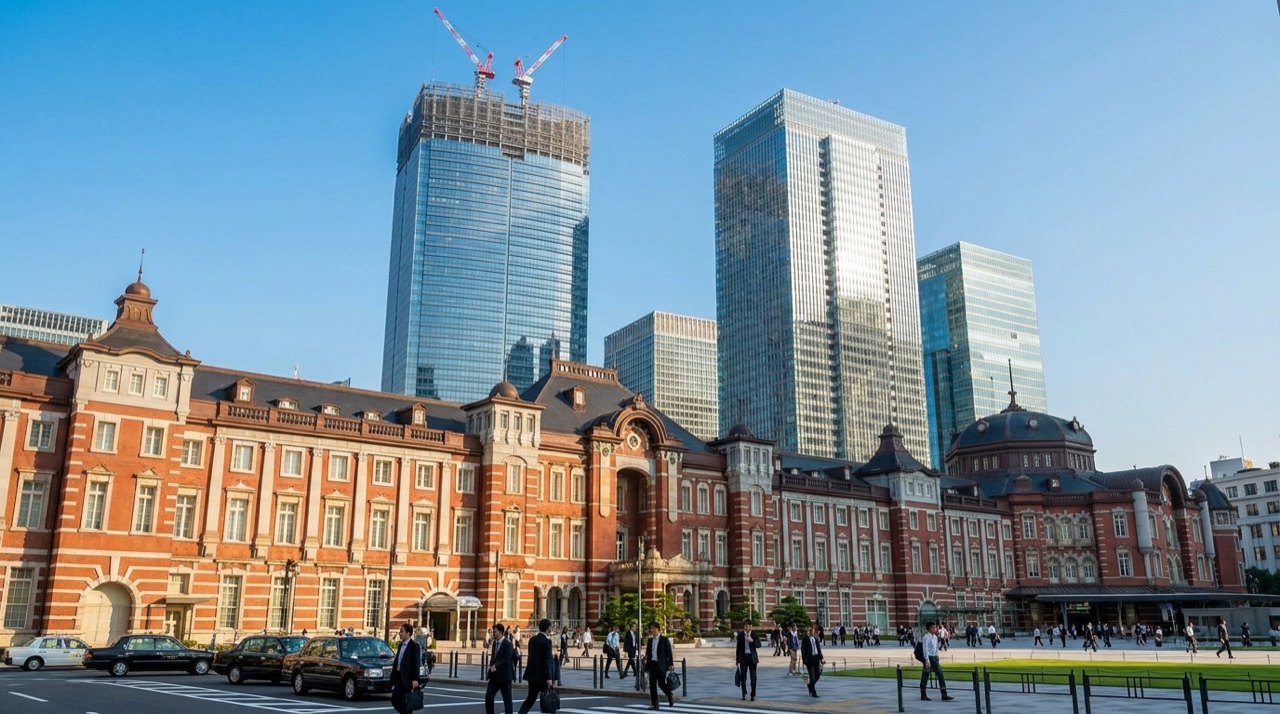
Yaesu, the east exit of Tokyo Station, used to be the scruffy back door, low-rise, dated, forgettable. That is over.
Tokyo Midtown Yaesu opened fully in March 2023, anchored by the 240-meter Yaesu Central Tower, with the Bulgari Hotel Tokyo occupying the top floors and a new long-distance bus terminal buried beneath it. Mitsui Fudosan put roughly 240 billion yen into it (directional). It reset the entire block’s address tier overnight.
Right next to it, TOFROM YAESU TOWER, a Tokyo Tatemono project of around 250 meters and 51 floors, completed in February 2026, connected directly into Tokyo Station via the Yaechika underground mall. Its sister building, TOFROM YAESU THE FRONT, is slated to finish the block in mid-2026. These are mixed-use: offices, retail, medical, conference and MICE space, a bus terminal, and a residential component on top.
That residential component is the point for you. There is very little housing in Yaesu proper, so the apartments that sit inside or beside these towers are scarce by construction. Scarcity plus a station-front, trophy-office address is the cleanest version of the spillover trade.
Nihonbashi: Mitsui’s home turf, mid-rebuild
Nihonbashi is the historic merchant heart of Tokyo and, not coincidentally, Mitsui Fudosan’s ancestral base. The company has been running a multi-decade “neighborhood creation” program here, and it is now entering its loudest phase.
Tokyo Midtown Nihonbashi, the fourth Midtown after Roppongi, Hibiya and Yaesu, is being built around the roughly 284-meter Nihonbashi Nomura Mitsui Tower, 52 storeys, with the overall project structurally completing in September 2026 and the full complex opening in autumn 2027 (directional). The retail piece, the COREDO Nihonbashi area, closes in late 2026 to be folded into the new commercial zone.
What this does to nearby homes is straightforward. A new Midtown is a demand magnet for premium office tenants, hotel guests and retail, and the residential stock around it, mostly mid-2010s and newer condos in Nihonbashi 1- to 3-chome, gets re-rated as the surrounding address improves. You are buying the halo, not the tower.
The expressway is coming down, and that is a real catalyst
For 77 years an elevated expressway has run directly over the Nihonbashi bridge, the literal historic center of Japan’s road network. Tokyo is burying it.
The underground replacement tunnel is targeted to open around fiscal 2035, with full removal of the overhead viaduct by fiscal 2040, a project costed at roughly 320 billion yen (directional). The payoff: an open-sky waterfront roughly 100 meters wide and 1,200 meters long, minutes from Tokyo Station, where there is currently a concrete deck and traffic noise.
This matters for a buyer with patience. Waterfront-restoration projects in dense cities reliably lift adjacent residential value, and this one runs on a published government and developer timeline rather than a rumor. The honest read: 2035 to 2040 is a long hold, and you are paying today partly for a view that arrives later. If your horizon is three years, discount it. If it is ten-plus, it is a genuine tailwind few other Tokyo districts can offer.
What the residential numbers actually look like
Treat all of these as directional, as of writing.
- New condos in Chuo-ku, which covers Nihonbashi and Ginza, broadly run in the 100 to 110 million yen range per unit, with central-Tokyo new stock averaging around 1.7 million yen per square meter.
- Central Tokyo, Chiyoda, Chuo and Minato, has seen new-condo pricing up more than 20% year on year, and the count of 100-million-yen-plus launches has surged.
- At the top, the Waldorf Astoria Residences Tokyo Nihonbashi, Asia-Pacific’s first under that brand, will sit on floors 48 to 51 of the Midtown Nihonbashi tower, 71 units from roughly 60 to 430 square meters, with move-ins from autumn 2027. Pricing is not public, which is itself the signal: this is a buy-the-brand-and-the-service product, priced accordingly.
The takeaway is not the headline number, it is the spread. You can play this district at the 100-million-yen mainstream-luxury tier or at the branded-residence ultra tier, and both sit on the same trophy-office foundation.
Liquidity: the quiet reason this district wins
For a foreign buyer, the most underrated feature of Yaesu and Nihonbashi is exit liquidity. Property next to a maxed-out CBD, with direct Tokyo Station access (Shinkansen, Narita and Haneda links, a dozen-plus rail lines), sells to the deepest possible pool: domestic institutions, relocating executives, and overseas buyers who all recognize the address without a map. You are not relying on a niche of buyers who happen to like a particular neighborhood.
That is the difference between a trophy-adjacent asset and a lifestyle asset. When you eventually sell, “200 meters from Tokyo Station, next to Tokyo Midtown” is a sentence that closes deals in any market. Compare that with a charming-but-obscure address that needs explaining.
How a foreign buyer should actually play it
A few honest, practical moves:
- Buy the halo, not the trophy. The towers themselves are mostly office and hotel. Your asset is the scarce residential stock around them. Map which buildings sit inside the 5-to-8-minute walk shed of Midtown Yaesu, TOFROM YAESU and Midtown Nihonbashi.
- Separate the timelines. The Yaesu office spillover is happening now. The Nihonbashi waterfront is a 2035-2040 payoff. Price each accordingly, and do not pay 2040 prices for a 2026 view.
- Decide your tier. Mainstream luxury around 100 million yen for liquidity and rental depth, or a branded residence if you want managed, hands-off ownership and a name that travels globally.
Use our ward guides to compare Chuo-ku against Chiyoda and Minato, run the numbers on holding costs and yield in our tools, and put two target buildings side by side in compare before you fly in.
This is one of the few Tokyo districts where the upside is structural, not sentimental. The office core is full, the overflow is engineered, and the homes around it are scarce. Pick your tier, pick your timeline, and shortlist three buildings this week, the spillover is not waiting for you to decide.